Gillicus

Gill-ee-cuss.
Updated on

Benjamin Gutierrez

Vertebrate Paleontologist

Benjamin Gutierrez is a leading expert on dinosaurs, particularly the mighty theropods. His fieldwork in South America has uncovered new species and provided insights into dinosaur social structures.

Cite Feedback Print

Name

Gillicus

Phonetic

Gill-ee-cuss.

Named By

Edward Drinker Cope‭ ‬-‭ ‬1875.

Classification

Chordata,‭ ‬Actinopterygii,‭ ‬Osteoglossomorpha,‭ ‬Ichthyodectiformes,‭ ‬Ichthyodectidae,‭ ‬Ichthyodectinae.

Diet

Carnivore.

Species

G.‭ ‬arcuatus

Size

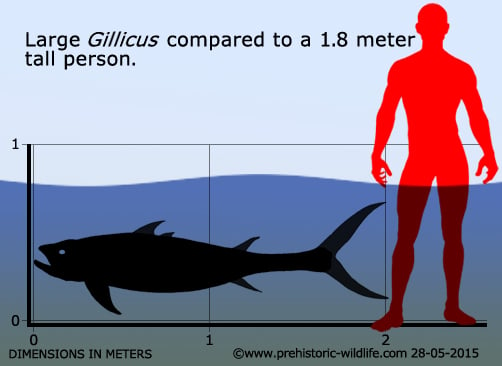
2‭ ‬meters long.

Known locations

USA.

Time Period

Coniacian through to the Maastrichtian of the Cretaceous.

Fossil representation

Numerous specimens.

Gillicus: Research Database

Theropoda · Cretaceous · Unknown


Research Note: Gillicus was a theropoda from the Cretaceous of Unknown, providing important data on prehistoric life and ecosystem dynamics.


Research FindingStatusGradeYearMethodCitationImpact
Hay 1898: Gillicus and related taxa
American Journal of Science
ConfirmedB1898FossilHay, American Journal of ScienceTaxonomy
Alvarado Ortega Porras Múzquiz 2009: Gillicus and related taxa
Boletín de la Sociedad Geológica Mexicana
ConfirmedC2009FossilAlvarado Ortega Porras Múzquiz, Boletín de la Sociedad Geológica MexicanaTaxonomy
Status:
Confirmed Direct evidence
Grade:
A Strong consensus
B Good evidence


What We Still Do Not Know About Gillicus

  • Complete skeletal morphology and ecological role.
  • Phylogenetic relationships within Theropoda.
  • Distribution and evolutionary history.

In Depth

       Gillicus was related to another Cretaceous bony fish, ‭‬Xiphactinus,‭ ‬and with it shared a streamlined body with a strongly upturned mouth.‭ ‬These characteristic features have led both fish to be compared to the modern day Tarpon,‭ ‬although neither of them are actually related to it.

       Gillicus had several small sharp teeth in its mouth and is thought to have used them filter zoo plankton.‭ ‬It is also thought by some to have eaten smaller fish by sucking them into its mouth with a vacuum when the jaws suddenly opened.‭ ‬Gillicus however was towards the bottom of the food chain,‭ ‬even being preyed upon by its larger relative Xiphactinus.‭ ‬A well-known specimen shows an entire Gillicus inside the belly of the Xiphactinus,‭ ‬although it may have ended up killing the larger predator though internal injury caused by its thrashing about inside.‭ ‬Gillicus would have also been prey to the sharks and mosasuars that were also active at the time and location.

Further Reading

– On the occurrence of Gillicus arcuatus (Cope, 1875) (Pisces, Ichthyodectiformes) in Mexico. – Boletin de la Sociedad Geologica Mexicana vol 61, issue 2. – Jes�s Alvarado-Ortega & H�ctor Porras- M�zquiz – 2009.
Adopt A Species
prehistoric-wildlife new logo

Love this species?

Adopt it today!

(UPDATED!)

SPECIES SPOTLIGHT