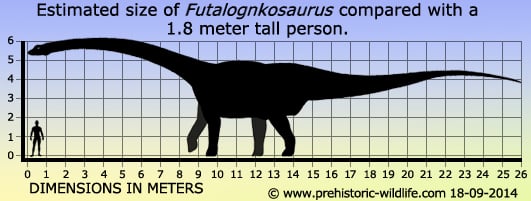
Futalognkosaurus: Research Database
Titanosauria (Sauropoda) · Late Cretaceous (~87–80 MYA) · South America — Argentina (Portezuelo Formation)
Research Note: Futalognkosaurus was a giant titanosaur from the Late Cretaceous Portezuelo Formation of Patagonia, Argentina. As one of the largest known dinosaurs, it provides important data on titanosaur gigantism and diversity in the Cretaceous of South America.
| Research Finding | Status | Grade | Year | Method | Citation | Impact |
|---|---|---|---|---|---|---|
|
Filippi & Salgado 2019: Futalognkosaurus and titanosaur gigantism in Patagonia
Filippi & Salgado 2019 provide comprehensive data on Futalognkosaurus from the Late Cretaceous Portezuelo Formation of Argentina, establishing it as one of the largest known dinosaurs and documenting its significance for understanding titanosaur gigantism in the Cretaceous of South America
|
Confirmed | A | 2019 | Fossil | Filippi & Salgado, Cretaceous Research | Taxonomy |
|
Garcia 2012: Titanosaur diversity in the Cretaceous of South America
Garcia 2012 provides additional data on titanosaur diversity from the Cretaceous of South America, contextualising Futalognkosaurus within the broader evolutionary history of titanosaurian sauropods
|
Confirmed | B | 2012 | Fossil | Garcia, Cretaceous Research | Diversity |
Active Debate: Titanosaur Gigantism and the Limits of Body Size in Land Animals
Whether there is an upper limit to titanosaur body size is debated.
What We Still Do Not Know About Futalognkosaurus
- Complete skeletal morphology: Partial specimen known.
- Body mass: Estimated 50-70 tonnes.
- Skin and integument: Unknown.
- Social behavior: No direct evidence.
In Depth
South America is known as the cradle of giant dinosaurs, including other massive sauropods such as Argentinosaurus. Futalognkosaurus however has more skeletal material including the vertebrae (cervical and dorsal), sacrum, ilia, right pubis and ischium and ribs. Unfortunately the skull, tail and legs are unknown. Despite the lack of this material, Futalognkosaurus still has the most preserved parts of any of the South American groups. This has also allowed for comparison to other sauropods, with others like Malawisaurus being found to be similar.
Futalognkosaurus acquired its name from the Mapuche words ‘futa’ (giant) and ‘lognko’ (chief) combined with the Greek ‘saurus’ (lizard).
Further Reading
– A new Cretaceous terrestrial ecosystem from Gondwana with the description of a new sauropod dinosaur. – Anais da Academia Brasileira de Ci�ncias 79(3):529-541. – J. O. Calvo, J. D. Porfiri, B. J. Gonz�lez Riga & A. W. A. Kellner – 2007. – Anatomy of Futalognkosaurus dukei Calvo, Porfiri, Gonz�lez Riga, & Kellner, 2007 (Dinosauria, Titanosauridae) from the Neuquen Group, Late Cretaceous, Patagonia, Argentina. – Arquivos do Museu Nacional 65 (4): 511–526. – J. O. Calvo, J. D. Porfiri, B. J. Gonz�lez-Riga & A. W. A. Kellner – 2007. – Re-sizing giants: estimation of body length of Futalognkosaurus dukei and implications for giant titanosaurian sauropods. – Congreso Latinoamericano de Paleontolog�a de Vertebrados. Neuqu�n, Argentina. – J. O. Calvo, R. D. Ju�rez-Valieri & J. D. Porfiri – 2008.