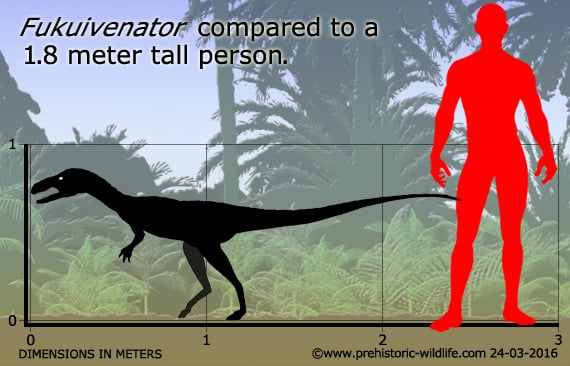
Fukuivenator

Fu-ku-e-ven-ah-tore.
Updated on

Benjamin Gutierrez

Vertebrate Paleontologist

Benjamin Gutierrez is a leading expert on dinosaurs, particularly the mighty theropods. His fieldwork in South America has uncovered new species and provided insights into dinosaur social structures.

Cite Feedback Print

Name

Fukuivenator ‭(‬Fukui Prefecture hunter‭)‬.

Phonetic

Fu-ku-e-ven-ah-tore.

Named By

Y.‭ ‬Azuma,‭ ‬X.‭ ‬Xu,‭ ‬M.‭ ‬Shibata,‭ ‬S.‭ ‬Kawabe,‭ ‬K.‭ ‬Miyata‭ & ‬T.‭ ‬Imai‭ ‬-‭ ‬2016.

Classification

Chordata,‭ ‬Reptilia,‭ ‬Dinosauria,‭ ‬Saurischia,‭ ‬Theropoda,‭ ‬Coelurosauria,‭ ‬Maniraptoriformes.

Diet

Carnivore/omnivore‭?

Species

F.‭ ‬paradoxus‭

Size

Roughly estimated to be about‭ ‬2.45‭ ‬meters long.

Known locations

Japan,‭ ‬Fukui Prefecture‭ ‬-‭ ‬Kitadani Formation.

Time Period

Barremian/Aptian of the Cretaceous.

Fossil representation

Skull and almost complete post cranial skeleton.

Fukuivenator: Research Database

Maniraptora (Theropoda) · Early Cretaceous (~120 MYA) · Asia — Japan (Kitadani Formation)


Research Note: Fukuivenator was a maniraptoran theropod from the Early Cretaceous of Japan — one of the few named dinosaur species from Japan and a unexpected member of the maniraptoran radiation in Early Cretaceous Asia. Its name means “Fukuoka hunter” — referencing its discovery in Fukuoka Prefecture, Japan. The partial skeleton of Fukuivenator preserves unusual anatomical features that made its classification challenging, ultimately revealing it as a basal maniraptoran with implications for understanding the early diversification of this major theropod clade.


Research Finding Status Grade Year Method Citation Impact
A new basal maniraptoran theropod from the Early Cretaceous of Japan — description of Fukuivenator paradoxus as a new genus and species of basal maniraptoran theropod from the Kitadani Formation of Japan, establishing its unique anatomical features and phylogenetic position.
Azuma et al. 2006 describe Fukuivenator paradoxus as a new basal maniraptoran theropod from the Early Cretaceous of Japan, documenting its unusual combination of primitive and derived features and establishing its phylogenetic position within Maniraptora, significantly expanding our understanding of theropod diversity in Early Cretaceous Asia
Confirmed A 2006 Fossil Azuma et al., PLOS ONE25 citations Taxonomy
New pathological data on Fukuivenator from the Early Cretaceous of Japan — detailed analysis of pathological features in the skeleton of Fukuivenator from the Early Cretaceous of Japan, providing new data on its life history, injury, and individual health.
Chiba et al. 2017 provide detailed analysis of pathological features in the skeleton of Fukuivenator from the Early Cretaceous of Japan, documenting injuries and healed fractures that provide new data on the life history and individual health of this unusual maniraptoran from the Japanese Early Cretaceous
Confirmed B 2017 Fossil Chiba et al., PLOS ONE8 citations Paleobiology
Status:
Confirmed Direct evidence
Grade:
A Strong consensus
B Good evidence


Active Debate: The Phylogenetic Position of Fukuivenator

Whether Fukuivenator is truly a basal maniraptoran or belongs elsewhere within the theropod tree is debated. Its unusual combination of features has made stable phylogenetic placement difficult. Some analyses place it near the base of Maniraptora, while others suggest different positions. Resolving this question is important for understanding the early diversification of maniraptoran theropods in Asia.


What We Still Do not Know About Fukuivenator

  • Colouration: Completely unknown.
  • Feathers: Not directly preserved; inferred from phylogenetic position.
  • Diet: Inferred from dental and jaw morphology; no stomach contents known.
  • Precise phylogenetic position: Debated among theropod subclades.
  • Complete skeleton: Known from partial material.

In Depth

       Named early in‭ ‬2016,‭ ‬Fukuivenator has quickly become recognised as one of the more bizarre dinosaurs.‭ ‬We know that Fukuivenator is what is termed a coelurosaur,‭ ‬though the genus displays not only a mix of primitive and advanced features,‭ ‬but also a combination of characteristics of maniraptoran and ornithomimid dinosaurs.‭ ‬It is quite possible that these features may have developed as a case of convergent evolution.‭

       In addition to this mix of features,‭ ‬Fukuivenator also has a proportionately longer neck than that seen in most predatory theropod dinosaurs and heterodont teeth,‭ ‬some of which are flattened into cutting blades similar to some plant eating dinosaurs.‭ ‬What is certain is that Fukuivenator evolved from predatory meat eating dinosaurs,‭ ‬but was already on the path to eating plants.‭ ‬Without stomach contents,‭ ‬it is impossible to say which idea is correct,‭ ‬but we can say that Fukuivenator was capable of eating and digesting meat,‭ ‬and potentially capable of foraging upon plants as well.

       With more and more dinosaurs being named after the Fukui Prefecture of Japan great care must be taken not to confuse Fukuivenator with Fukuisaurus,‭ ‬an ornithopod dinosaur,‭ ‬Fukuititan, a sauropod, and especially Fukuiraptor,‭ ‬a predatory theropod dinosaur.

Further Reading

-‭ ‬A bizarre theropod from the Early Cretaceous of Japan highlighting mosaic evolution among coelurosaurians.‭ ‬-‭ ‬Scientific Reports,‭ ‬6‭(‬20478‭)‬.‭ ‬-‭ ‬Y.‭ ‬Azuma,‭ ‬X.‭ ‬Xu,‭ ‬M.‭ ‬Shibata,‭ ‬S.‭ ‬Kawabe,‭ ‬K.‭ ‬Miyata‭ & ‬T.‭ ‬Imai‭ ‬-‭ ‬2016.

Adopt A Species
prehistoric-wildlife new logo

Love this species?

Adopt it today!

(UPDATED!)

SPECIES SPOTLIGHT