In Depth
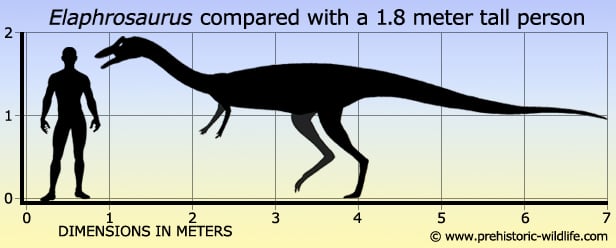
Elaphrosaurus has been something of an enigma for palaeontologists as while it is generally regarded as a ceratosaur, its proportions are similar to some other kinds of theropods. The overall appearance of Elaphrosaurus is that of a lightweight hunter that relied more upon speed rather than strength to take down prey. The tibia in particular is longer than the femur which is a good sign that Elaphrosaurus would have been a fast runner. In fact it is these leg proportions that once led to the suggestion that Elaphrosaurus may have been a primitive ornithomimosaur after it was initially thought to have been a late surviving coelophysid. The latter conclusion was based upon the long neck that probably supported a smaller skull than other theropods which are known to have larger skulls on shorter necks.
Some changes regarding the assignment of fossils have taken place over the years. A former species named from Nigerian fossil material called Elaphrosaurus gautieri was renamed in 2004 as Spinostropheus. Other remains from the Morrison Formation of the United States have been regarded as possibly being the same genus as Elaphrosaurus, but at the time of writing are not yet officially recognised.
Further Reading
– Ueber Elaphrosaurus bambergi und die Megalosaurier aus den Tendaguru-Schichten Deutsch-Ostafrikas [On Elaphrosaurus bambergi and the megalosaurs of the Tendaguru Formation of German East Africa] – Sitzungsberichte der Gesellschaft Naturforschender Freunde zu Berlin 1920:225-235 – W. Janensch – 1920. – Elaphrosaurus, an ornithomimid dinosaur from the Upper Jurassic of North America and Africa – Pal�ontologische Zeitschrift. 56, 265-275 – P. Galton – 1982. – The second record of the African theropod Elaphrosaurus (Dinosauria, Ceratosauria) from the Western Hemisphere – Neues Jahrbuch f�r Geologie und Pal�ontologie Monatshefte. 2001(9), 565-576 – Chure – 2001.