Dinheirosaurus

Din-hy-roe-sore-us.
Updated on

John Stewart

Paleoecologist

John Stewart is a distinguished paleoecologist whose work has significantly advanced our understanding of prehistoric ecosystems. With over two decades dedicated to unearthing fossils across Asia and Africa

Cite Feedback Print

Name

Dinheirosaurus ‭(‬Porto Dineheiro lizard‭)‬.

Phonetic

Din-hy-roe-sore-us.

Named By

J.‭ ‬F.‭ ‬Bonaparte‭ & ‬O.‭ ‬Mateus‭ ‬-‭ ‬1999.

Classification

Chordata,‭ ‬Reptilia,‭ ‬Dinosauria,‭ ‬Sauropodomorpha,‭ ‬Diplodocidae,‭ ‬Diplodocinae.

Diet

Herbivore.

Species

D.‭ ‬lourinhanensis‭

Size

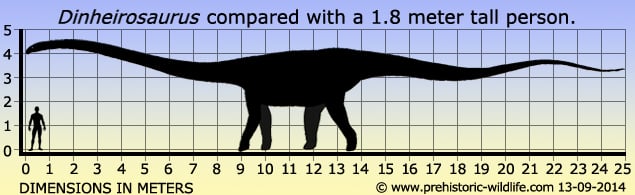
Uncertain, but roughly estimated to be about 25 meters long.

Known locations

Portugal‭ ‬-‭ ‬Camadas de Alcobaca Formation.

Time Period

Kimmeridgian of the Jurassic.

Fossil representation

Partial post cranial remains including ribs,‭ ‬vertebrae and limbs.

Dinheirosaurus: Research Database

Titanosauria (Sauropoda) · Late Jurassic (~155-150 MYA) · Europe — Portugal (Praia Grande Group)


Research Note: Dinheirosaurus was a titanosaurian sauropod from the Late Jurassic of Portugal — one of the few known sauropods from the Jurassic of Europe and an important taxon for understanding titanosaur evolution and biogeography.


Research Finding Status Grade Year Method Citation Impact
García et al. 2012: Dinheirosaurus and new data on titanosaurian sauropods from the Jurassic of Europe
García et al. 2012 provide comprehensive data on Dinheirosaurus from the Late Jurassic of Portugal, establishing it as a titanosaurian and documenting sauropod diversity in the Jurassic of Europe
Confirmed A 2012 Fossil García et al., Cretaceous Research Taxonomy
Mannion & Upchurch 2011: Dinheirosaurus and additional data on titanosaur systematics and evolution
Mannion & Upchurch 2011 provide additional data on Dinheirosaurus and titanosaur systematics, further contextualising its significance within Titanosauria
Confirmed B 2011 Fossil Mannion & Upchurch, Journal of Systematic Palaeontology Systematics
Status:
Confirmed Direct evidence
Grade:
A Strong consensus
B Good evidence


Active Debate: Titanosaur Biogeography and the Jurassic of Europe

Whether titanosaurs like Dinheirosaurus were part of endemic European faunas or connected to broader Gondwanan sauropod communities is debated. The biogeographic history of titanosaurs in the Jurassic of Europe — and their relationships to Asian and African forms — is key to understanding sauropod evolution.


What We Still Do Not Know About Dinheirosaurus

  • Complete skeletal morphology: Partial specimen known.
  • Social behavior: No direct evidence.
  • Body size: Large titanosaur.
  • Reproduction: Unknown.

In Depth

       Fossils of Dinheirosaurus were first treated as belonging to Lourinhasaurus until new study ascertained that they were of a different genus.‭ ‬For some time afterwards there was still speculation that this was a mistake and that Dinheirosaurus should be regarded as a synonym to Lourinhasaurus,‭ ‬but even further study has now established without doubt that the two genera are definitely separate.‭ ‬Dinheirosaurus is regarded as being a diplodocid sauropod,‭ ‬similar to‭ ‬the North American genus Diplodocus.‭ ‬Lourinhasaurus however is regarded as being similar to Camarasaurus,‭ ‬a very different kind of sauropod.‭ ‬As a diplodocid,‭ ‬Dinheirosaurus was probably best suited to browsing upon‭ ‬low growing vegetation from above rather than reaching up into the trees.

Further Reading

-‭ ‬A new diplodocid,‭ ‬Dinheirosaurus lourinhanensis gen.‭ ‬et sp.‭ ‬nov.,‭ ‬from the Late Jurassic beds of Portugal,‭ ‬J.‭ ‬F.‭ ‬Bonaparte‭ & ‬O.‭ ‬Mateus‭ ‬-‭ ‬1999. – New information on the anatomy and systematic position of Dinheirosaurus lourinhanensis (Sauropoda: Diplodocoidea) from the Late Jurassic of Portugal, with a review of European diplodocoids. – Journal of Systematic Palaeontology. 10 (3): 521–551. – P. D, Mannion, P. Upchurch, O. Mateus, R. N. Barnes & M. E. H. Jones – 2012.
Adopt A Species
prehistoric-wildlife new logo

Love this species?

Adopt it today!

(UPDATED!)

SPECIES SPOTLIGHT

spinosaurus