In Depth
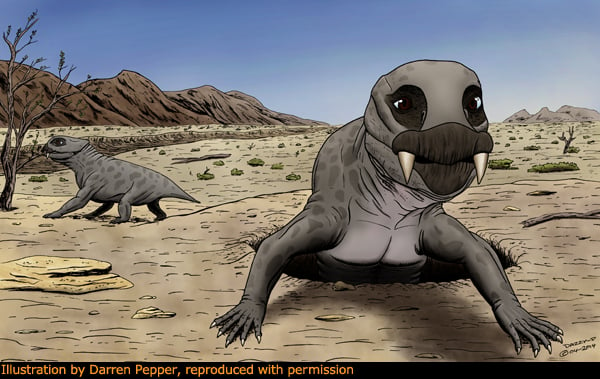
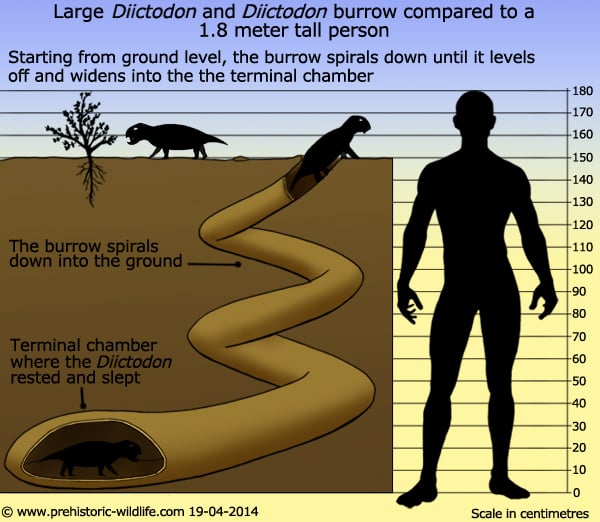
Diictodon was a burrowing dicynodont that appears to have been extremely numerous and widespread. It had a short round body, stubby legs and sharp claws on the front feet, all very good adaptations for burrowing life. Although Diictodon did not build interconnecting burrows with others of its species, evidence suggests that large numbers would gather and burrow in close proximity to one another. Diictodon burrows typically spiral down into the ground before levelling off into the terminal chamber where the Diictodon would have slept and reared young. Although burrows could vary in size, larger burrows are known to have reached depths as far as one and a half meters into the ground.
Diictodon also had an oversized head for its body with a cropping beak that would have been suitable for feeding on the arid vegetation of the time. Diictodon, like other dicynodonts, possessed a pair of large tusks that erupted and pointed down from the upper jaw. While it has been suggested that male and female Diictodon both had tusks, a 2005 study by Corwin Sullivan cast doubt upon this. In this study Sullivan noted that only the type species of Diictodon, D. feliceps can be distinguished with clarity, and that other species are probably synonymous with this. It was also then noted that since known Diictodon skulls, come in both tusked and non-tusked forms, they may represent a distinction between males and females, with the males being tusked.
Many Diictodon remains have been found inside of their burrows. It’s plausible that they may have been flooded when an ancient river burst its banks at the onset of the wet season. This is a valid theory as flood plains often prove very fertile for plant species to flourish, and so it could be that in their search for food the Diictodon got too close to the source of their life.
Further Reading
– Functional aspects of the postcranial anatomy of the Permian dicynodont Diictodon and their ecological implications – Palaeontology, vol 46 issue 1, pages 151-183 – Sanghamitra Ray & Anusuya Chinsamy – 2003. – Diictodon feliceps (Therapsida, Docynodontia): Bone Histology, Growth and Biomechanics – Journal of Vertebrate Paleontology 24(1): 180-194 – Sanghamitra Ray & Anusuya Chinsamy – 2004. – Cranial Anatomy and Taxonomy of the Late Permian Dicynodont Diictodon – Annals of Carnegie Museum 74(1):45-75 – Corwin Sullivan – 2005.