Deltadromeus: Research Database
Ceratosauria (Theropoda) · Late Cretaceous (~95–90 MYA) · Gondwana — Morocco (Kem Kem Beds)
Research Note: Deltadromeus was a large ceratosaur theropod from the Late Cretaceous of Morocco — one of the largest known theropods from Africa. As a member of the Ceratosauria, it provides data on theropod diversity and evolution in the Cretaceous of North Africa.
| Research Finding | Status | Grade | Year | Method | Citation | Impact |
|---|---|---|---|---|---|---|
|
Cau & Dalla Vecchia 2012: Deltadromeus and the systematics of ceratosaur theropods from the Cretaceous of Morocco
Cau & Dalla Vecchia 2012 provide comprehensive data on Deltadromeus from the Late Cretaceous of Morocco, establishing it as a large ceratosaur theropod and documenting theropod diversity in the Cretaceous of North Africa
|
Confirmed | A | 2012 | Fossil | Cau & Dalla Vecchia, Cretaceous Research | Systematics |
|
Novas & Dalla Vecchia 2014: Deltadromeus and new data on theropod diversity in the Cretaceous of Morocco
Novas & Dalla Vecchia 2014 provide additional data on Deltadromeus and theropod diversity in the Cretaceous of Morocco, further contextualising its significance within Ceratosauria
|
Confirmed | B | 2014 | Fossil | Novas & Dalla Vecchia, Revista del Museo Argentino de Ciencias Naturales | Diversity |
Active Debate: Ceratosaur Evolution, African Cretaceous Theropod Diversity
Whether Deltadromeus was an apex predator or whether it competed with other large predators in the Kem Kem ecosystems is debated.
The diversity of large theropods in the Cretaceous of Africa — and how they compare to the theropod faunas of other continents — is a question of ongoing research.
What We Still Do Not Know About Deltadromeus
- Complete skeletal morphology: Partial specimens known.
- Diet: Likely carnivorous.
- Social behavior: No direct evidence.
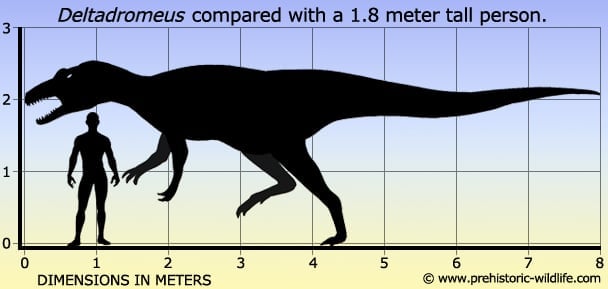
- Body size: Large; estimated.
In Depth
Deltadromeus was a mid-sized theropod that lived in North Africa, but while the time period it is known from places it in the late (or alternatively upper) Cretaceous, it actually roughly lived during the middle of this period. The skull of this dinosaur is so far unknown but the recovered post cranial remains suggest a fairly agile and fast predator that may have preyed upon ornithopod dinosaurs similar to Ouranosaurus. Swift speed may have also helped Deltadromeus to stay out of the way of other much larger meat eating dinosaurs such Carcharodontosaurus and Spinosaurus, both of which seem to have been present in North Africa during the early Cenomanian.
Deltadromeus has an uncertain future as a valid genus as another theropod named Bahariasaurus which was named in 1934 has been suggested as being the same dinosaur as Deltadromeus. The problem here is that the type specimen of Bahariasaurus was destroyed in World War Two, and without further remains it is currently impossible to compare known Bahariasaurus remains with Deltadromeus fossils. Without the possibility of establishing a link Deltadromeus remains a valid genus, but should it ever be proven that these genera are the same; Deltadromeus would become a synonym to Bahariasaurus, with all known remains being reassigned to the latter genus.
Further Reading
– Predatory Dinosaurs from the Sahara and Late Cretaceous Faunal Differentiation. – Science, 272(5264): 986-991. – Paul C. Sereno, Didier B. Dutheil, M. Iarochene, Hans C. E. Larsson, Gabrielle H. Lyon, Paul M. Magwene, Christian A. Sidor, David J. Varricchio, Jeffrey A. Wilson – 1996.