In Depth
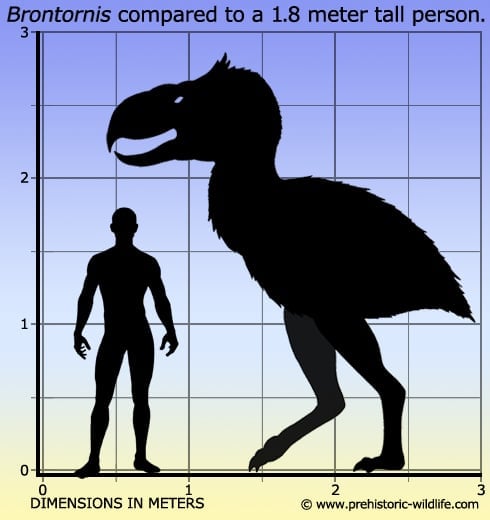
Brontornis was easily one of the largest of the known South American ‘terror birds’, and as a member of the Brontornithinae it is noted as being one of the most robust in build. Whereas some terror birds could use their speed to run down prey, Brontornis would have been more suited to ambush tactics against larger prey. This would mean staying amongst trees and tall vegetation to hide its profile while prey wandered close enough for a strike.
The heavy build of Brontornis would have been key to its hunting strategy, essentially relying upon brute force to bring its prey down. One reason for this is that without speed to keep pace with its prey it would need to take it down quick before the prey had time to escape. Another is that as a larger bird it would need to eat larger and more powerful prey items to have enough food to survive. This meant a focus upon prey that could have withstood weaker blows necessitating the requirement for the ability to inflict stronger impacts.
Brontornis placement within the Phorusrhacidae has been questioned on the grounds of its similarities with anseriform birds, more specifically like the large flightless birds of Australia such as Dromornis and Bullockornis. However this similarity may actually be a simple case of convergent evolution as studies of the vertebra have since suggested that Brontornis is indeed more like the other phorusrhacids. This also helps to tie in South America’s geographic isolation from the rest of the world during the Miocene.
Further Reading
– Catalogue des Oiseaux Fossiles de la Republique Argentine conserves au Musee de la Plata. – Anales del Museo de la Plata 1:1-71 – F. P. Moreno & A. Mercerat – 1891. – Systematic revision of the Phorusrhacidae (Aves: Ralliformes) – Pap�is Avulsos de Zoologia 43 (4): 55–91 – H. M. F. Alvarenga & e. H�fling – 2003. – Brontornis burmeisteri Moreno & Mercerat, un Anseriformes (Aves) gigante del Mioceno Medio de Patagonia, Argentina. – Revista del Museo Argentino de Ciencias Naturales, n.s. 9, 15-25 – F. Agnolin – 2007.