In Depth
Biarmosuchus is noted as being a primitive theraspid, the group of mammal like reptiles that evolved from the pelycosaurs, and whose descendents would go onto becoming the first mammals.
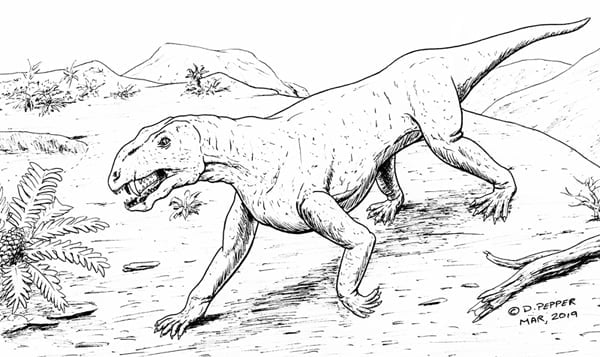
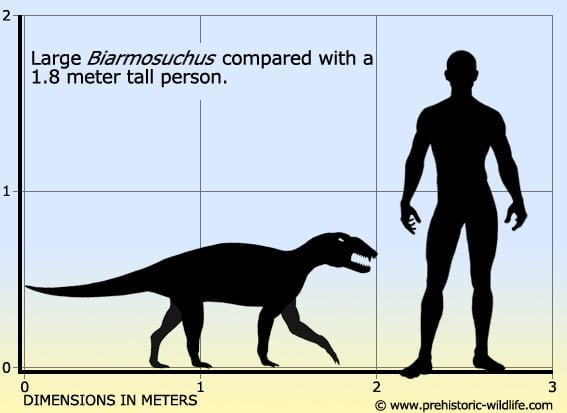
As a predator, Biarmosuchus was likely a fast hunter capable of running down its prey. This is evidenced by its long slender limbs that carried the body high off the ground by supporting the body from underneath instead of being sprawled out to the sides like its pelycosaur ancestors. Further the feet also point forwards indicating frequent forward locomotion at speed.
The dentition of Biarmosuchus is composed of eight smaller incisors at the front, followed by six canine teeth either side towards the middle. The first two of these canines were much larger than the others and were likely the main weapons that Biarmosuchus employed to hold onto prey and possibly deliver a killing bite.
As is commonly seen in predators, the skull of Biarmosuchus is wider at the rear than the snout. This has the effect of angling the eyes slightly forwards and enhancing prey detection. The extra width also allows for more powerful bite muscles, greatly increasing the killing potential of the canine teeth.
Further Reading
– Late Permian terrestrial vertebrates, USA and USSR. – Transactions of the American Philosophical Society, new series, 52: 1–224. – E. C. Plsen – 1962. – New Facts about the Fauna of the Upper Permian of the USSR – Journal of Geology, 73:117– 30 – P. K. Chudibov – 1965. – Biarmosuches from the Ocher Faunal Assemblage of Eastern Europe. – Paleontological Journal, v. 33, n. 3, p. 289-296. – M. F. Ivakhnenko – 1999.