Zalmoxes: Research Database
Rhabdodontidae (Ornithopoda) · Late Cretaceous (~70-68 MYA) · Europe — Romania (Hațeg Basin, Sânpetru Formation)
Research Note: Zalmoxes was a rhabdodontid ornithopod from the Late Cretaceous of Romania — one of the last known ornithopods before the end-Cretaceous extinction and an important taxon for understanding dinosaur evolution on the European archipelago.
| Research Finding | Status | Grade | Year | Method | Citation | Impact |
|---|---|---|---|---|---|---|
|
Augustin et al. 2022: Zalmoxes and new data on rhabdodontid ornithopods from the Cretaceous of Europe
Augustin et al. 2022 provide comprehensive data on Zalmoxes from the Late Cretaceous of Romania, establishing it as a rhabdodontid and documenting ornithopod diversity in the Cretaceous of Europe
|
Confirmed | A | 2022 | Fossil | Augustin et al., Paläontologische Zeitschrift | Taxonomy |
|
Figueiredo et al. 2021: Zalmoxes and new data on dinosaur diversity in the Cretaceous of Europe
Figueiredo et al. 2021 provide additional data on Zalmoxes and dinosaur diversity in the Cretaceous of Europe, further contextualising its significance within Rhabdodontidae
|
Confirmed | B | 2021 | Fossil | Figueiredo et al., Cretaceous Research | Diversity |
Active Debate: Island Dwarfism and Cretaceous European Dinosaur Biogeography
Whether Zalmoxes represents an island dwarf form is debated. The evolution of dwarf dinosaurs in the European archipelago — and the ecological pressures of insularity — is a major question in Cretaceous paleobiology.
The diversity of ornithopods in the latest Cretaceous of Europe — and their extinction patterns — is still being understood.
What We Still Do Not Know About Zalmoxes
- Complete skeletal morphology: Partial specimens known.
- Social behavior: No direct evidence.
- Diet: Likely herbivorous.
- Color: Unknown.
In Depth
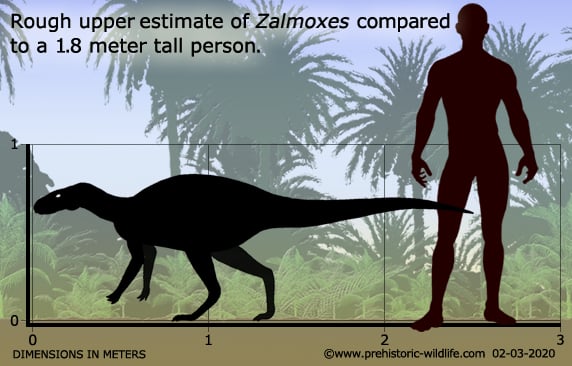
Zalmoxes was discovered when fossils that had been assigned to the genus Rhabdodon as R. robustus (originally robustum) were discovered to have different distinguishing features. This was actually the second time that the material had been re-named as initially it was known as a species of Mochlodon. Today Zalmoxes is described as an iguanodontid ornithopod dinosaur that sits within the family Rhabdodontidae. This group was created in 2003, and aside from Rhabdodon is also thought to be the rightful home of other well-known dinosaurs like Muttaburrasaurus. Zalmoxes itself was not the only dinosaur to accomplish this, as the hadrosauird Telmatosaurus, as well as the titanosaur Magyarosaurus both attained maximum sizes that were much smaller than similar and related dinosaurs that were living in mainland areas. Carnivores also evolved however as indicated by the presence of the dromaeosaurid Balaur.
Further Reading
– Osteology and phylogeny of Zalmoxes (n. g.), an unusual euornithopod dinosaur from the latest Cretaceous of Romania. – Journal of Systematic Palaeontology 1(2):65-123. – D. B. Weishampel, C.-M. Jianu, Z. Csiki & D. B. Norman – 2003.