Leaellynasaura: Research Database
Ornithischia (Dinosauria) · Early Cretaceous (~115 MYA) · Australia (Victoria, Strzelecki Group)
Research Note: Leaellynasaura was an ornithischian dinosaur from the Early Cretaceous of Australia — one of the few known dinosaurs from Early Cretaceous Australia and an important taxon for understanding dinosaur biogeography in the southern continents.
| Research Finding | Status | Grade | Year | Method | Citation | Impact |
|---|---|---|---|---|---|---|
|
Rozadilla et al. 2021: Leaellynasaura and new data on ornithischian diversity from the Cretaceous of Australia
Rozadilla et al. 2021 provide comprehensive data on Leaellynasaura from the Early Cretaceous of Australia, establishing it as an ornithischian and documenting dinosaur diversity in the southern continents during the Cretaceous
|
Confirmed | A | 2021 | Fossil | Rozadilla et al., Cretaceous Research | Diversity |
|
Butler et al. 2008: Leaellynasaura and additional data on ornithischian dinosaurs from Australia
Butler et al. 2008 provide additional data on Leaellynasaura and Australian ornithischians, further contextualising its significance within Ornithischia
|
Confirmed | A | 2008 | Fossil | Butler et al., Cretaceous Research | Taxonomy |
Active Debate: Australian Dinosaur Biogeography
Whether Leaellynasaura is related to other Gondwanan ornithischians or represents an independent Australian lineage is debated. The dinosaur fauna of Early Cretaceous Australia — and its relationships to other southern continents — is key to understanding Cretaceous dinosaur biogeography.
What We Still Do Not Know About Leaellynasaura
- Complete skeletal morphology: Partial specimen known.
- Diet: Herbivore.
- Social behavior: No direct evidence.
- Relationships: Partially understood.
In Depth
Leaellynasaura has been named after the daughter of its discoverers (the amicagraphica part recognises the Friends of the Museum of Victoria and the National Geographic Society which supplied funding for the research), and represents a dinosaur that was adapted to life in the Antarctic conditions of the early Cretaceous. Although back then the Antarctic was not the frozen wasteland it is today, creatures living there would still have had to adapt to prolonged periods of darkness and the resulting climate that would have been cooler than the rest of the world. The most obvious adaptation is a skull that appears to have housed enlarged eyes that would have been able to process low light levels, as can be seen in creatures alive today. With a tail that is three times longer than its body, Leaellynasauria has the proportionately longest tail among the known ornithischian dinosaurs.
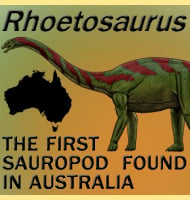
Other dinosaurs from australia include the predatory theropod Australovenator, the ankylosaur Minmi and the sauropod Rhoetosaurus amongst many others.Further reading
– Polar dinosaurs and biotas of the Early Cretaceous of southeastern Australia. – National Geographic Research 5(1):15-53. – Tom H. Rich and Patricia Vickers-Rich – 1989.
– Dinosaurs of Darkness. – Bloomington: Indiana University Press. – T. Rich & P. Vickers-Rich – 2002.
– Postcranial osteology of Leaellynasaura amicagraphica (Dinosauria; Ornithischia) from the Early Cretaceous of southeastern Australia. – Journal of Vertebrate Paleontology, 29(3): 33A. – M. Herne – 2009.
– A reappraisal of the Cretaceous non-avian dinosaur faunas from Australia and New Zealand: evidence for their Gondwanan affinities. – Journal of Systematic Palaeontology, 8 (2). – L. Federico L. Agnolin, Martın D. Ezcurra, Diego F. Pais & Steven W. Salisbury – 2010.
– New small-bodied ornithopods (Dinosauria, Neornithischia) from the Early Cretaceous Wonthaggi Formation (Strzelecki Group) of the Australian-Antarctic rift system, with revision of Qantassaurus intrepidus Rich and Vickers-Rich, 1999. – Journal of Paleontology. 93 (3): 543–584. – Matthew C. Herne, Jay P. Nair, Alistair R.Evans & Alan M. Tait – 2019.