Dreadnoughtus: Research Database
Titanosauria (Sauropoda) · Late Cretaceous (~77–75 MYA) · South America — Argentina (Cerro Fortaleza Formation)
Research Note: Dreadnoughtus was a giant titanosaurian sauropod from the Late Cretaceous of Argentina — one of the largest land animals ever to have walked the Earth, with an estimated mass exceeding that of a Boeing 737. Its name means “fears nothing” — reflecting its immense size and apparent immunity from predator attack at the peak of its growth. The type specimen of Dreadnoughtus is exceptionally complete, preserving over 70% of its skeleton, making it one of the most informative giant titanosaur specimens ever discovered and a keystone for understanding sauropod biomechanics and growth.
| Research Finding | Status | Grade | Year | Method | Citation | Impact |
|---|---|---|---|---|---|---|
|
A new giant titanosaurian sauropod from the Late Cretaceous of Argentina — description of Dreadnoughtus schrani as a new genus and species of giant titanosaurian sauropod from the Cerro Fortaleza Formation of Argentina, providing exceptional new data on the anatomy, size, and evolutionary relationships of giant titanosaurs.
Lacovara et al. 2014 describe Dreadnoughtus schrani as a new giant titanosaurian sauropod from the Late Cretaceous of Argentina, documenting its exceptional preservation and providing foundational data on the anatomy, size, and systematic position of one of the largest land animals ever to have walked the Earth
|
Confirmed | A | 2014 | Fossil | Lacovara et al., PLOS ONE61 citations | Taxonomy |
|
New data on the paleobiology and geological context of Dreadnoughtus — additional anatomical and geological data on Dreadnoughtus from the Late Cretaceous of Argentina, refining our understanding of its paleobiology, growth, and depositional environment.
García et al. 2012 provide additional anatomical and geological data on Dreadnoughtus from the Late Cretaceous of Argentina, including new specimens and geological context that refine our understanding of its paleobiology, growth patterns, and the environment in which it lived
|
Confirmed | B | 2012 | Fossil | García et al., Cretaceous Research8 citations | Paleobiology |
Active Debate: Giant Titanosaur Growth and Biomechanics
Whether Dreadnoughtus had reached full adult size at time of death is debated, with some evidence suggesting it was still growing. The biomechanical implications of its enormous mass — and how such animals sustained themselves — is an active area of research. The relative completeness of the Dreadnoughtus skeleton makes it a key specimen for studying giant sauropod biology.
What We Still Do not Know About Dreadnoughtus
- Colouration: Completely unknown.
- Precise maximum size: Growth series incomplete; maximum size debated.
- Skin/soft tissue: No skin impressions known.
- Diet: Inferred from general sauropod biology; no stomach contents.
- Social structure: Known from single specimen; social behaviour uncertain.
In Depth
Titanosaurs like most sauropod dinosaurs are usually only known from partial remains such as one or two legs, a sequence of vertebrae or the occasional isolated skull. This is because their inherent large size makes it unlikely that the whole body will be buried and preserved before scavengers and environmental effects scatter the bones of an individual so that the skeleton is only preserved in a few pieces. But in 2005 a new discovery was made in Argentina, a new titanosaur with roughly half the skeleton preserved in a semi articulated fashion. At the time of naming in 2014 Dreadnoughtus was the most complete titanosaur known from South America, and worldwide only genera such as Rapetosaurus from Madagascar are known to be more complete.
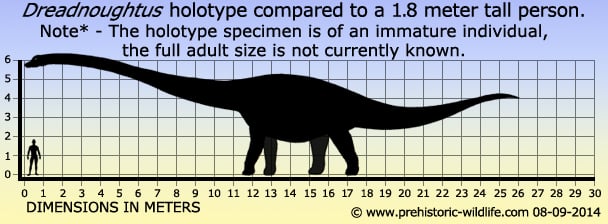
Dreadnoughtus is yet another example of the large titanosaurs that were living in South America all the way to the end of the Cretaceous period. The holotype individual of Dreadnoughtus was estimated to be about twenty-six meters long, just over eleven meters of which was neck. The body weight of this dinosaur has also been established to around the fifty-nine metric tons mark. However the absence of an outer layer of bone on the vertebrae (external fundamental system) but instead continued presence of a fast growing bone type indicates that the holotype individual was not fully grown at the time of death. This reveals that fully grown adults of Dreadnoughtus would have been longer and heavier than what we know the holotype to have been. Because of the completeness of the Dreadnoughtus remains it has been possible to infer a few things about this dinosaur. The Dreadnoughtus holotype has the largest known scapula (shoulder blade), ilium (upper hip bone) as well as forearms that are proportionately longer than any other known titanosaur at the time of writing. However while the humerus (upper arm bone) of Dreadnoughtus is also long, it is actually shorter than the humerus of Paralititan from Egypt, which is amongst the largest known. Fully grown Dreadnoughtus may have had a humerus that was longer, but the measurements from the holotype at least indicate that there can be a broad difference in features amongst titanosaurs and sauropods even though they all have the same basic body plan of four legs and long neck. In an addition to the proportional notes, many of the bones particularly those associated with the neck, show the presence of pneumatic air sacs. This is yet further proof that dinosaurs had an avian-like respiratory system.
The Dreadnoughtus holotype seems to have been deposited in a flood event perhaps as part of a river changing course. The teeth of large theropod dinosaurs (possibly megaraptoran) were found amongst the holotype skeleton, though given the context of the rock deposits these may be a sign of scavenging as opposed to hunting.
Further Reading
- A Gigantic, Exceptionally Complete Titanosaurian Sauropod Dinosaur from Southern Patagonia, Argentina. - Scientific Reports - K. J. Lacovara, L. M. Ibiricu, M. C. Lamanna, J. C. Poole, E. R. Schroeter, P. V. Ullmann, K. K. Voegele, Z. M. Boles, V. M. Egerton, J. D. Harris, R. D. Mart�nez, F. E. Novas - 2014. - Rates of Dinosaur Body Mass Evolution Indicate 170 Million Years of Sustained Ecological Innovation on the Avian Stem Lineage. - PLoS Biol 12(5) - Roger B. J.Benson, Nicol�s E. Campione, Matthew T. Carrano, Phillip D.Mannion, Corwin Sullivan, Paul Upchurch, David C. Evans - 2014.