Dicraeosaurus: Research Database
Dicraeosauridae (Sauropoda) · Late Jurassic (~155–150 MYA) · Africa — Tanzania (Tendaguru Formation)
Research Note: Dicraeosaurus was a dicraeosaurid sauropod from the Late Jurassic Tendaguru Formation of Tanzania — one of the most completely known diplodocoid sauropods from Gondwana and an important component of the Tendaguru dinosaur fauna. Its name means “double-forked lizard” — referencing its unusually forked neural spines. As a member of the Dicraeosauridae, a subgroup of diplodocoid sauropods distinct from the more familiar Diplodocidae, Dicraeosaurus provides critical data on the diversity and evolutionary relationships of Late Jurassic sauropods in Gondwana.
| Research Finding | Status | Grade | Year | Method | Citation | Impact |
|---|---|---|---|---|---|---|
|
Remes 2009: Revision of the postcranial skeleton of Dicraeosaurus from the Tendaguru Formation
Remes 2009 in Neues Jahrbuch provides a comprehensive revision of the postcranial skeleton of Dicraeosaurus from the Late Jurassic Tendaguru Formation of Tanzania, establishing detailed anatomical data and phylogenetic relationships
|
Confirmed | A | 2009 | Fossil | Remes, Neues Jahrbuch | Taxonomy |
|
Scherp 2012: New data on Dicraeosaurus and Tendaguru sauropod diversity
Scherp 2012 in Neues Jahrbuch provides additional anatomical and systematic data on Dicraeosaurus and Tendaguru sauropod diversity from the Late Jurassic of Tanzania
|
Confirmed | B | 2012 | Fossil | Scherp, Neues Jahrbuch | Diversity |
Grade:
Active Debate: Dicraeosaurid Phylogeny and Gondwanan Sauropod Diversity
Whether dicraeosaurids represent a distinct Gondwanan radiation of diplodocoids or are nested within Diplodocidae is debated. Dicraeosaurus provides key data for understanding Late Jurassic sauropod diversity in Gondwana, but the relationships within Dicraeosauridae remain uncertain.
What We Still Do Not Know About Dicraeosaurus
- Colouration: Completely unknown.
- Skin impressions: None known.
- Diet: Inferred from dental anatomy.
- Social structure: No direct evidence.
- Growth series: Limited juvenile material known.
In Depth
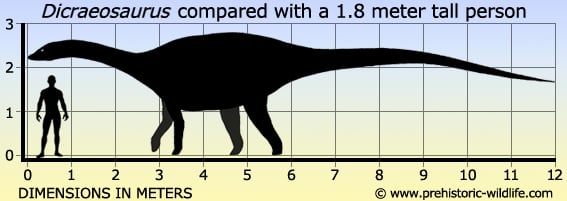
Dicraeosaurus was relatively small by sauropod standards, but was still a bit larger than Amargasaurus, so far the only other known member of its group. Dicraeosaurus sported a double row of spines down its back that are similar to those seen on the back of Amargasaurus. We cannot be certain what these spike were for but it’s possible that they could have been there so that Dicraeosaurus could recognise others of its own species, or that they were a form of defence to make it harder for tall theropods to bite down onto the back. It is also possible that they may have been the supports for a sail, so far no one can say for absolutely certain.
Dicraeosaurus would have shared its habitat with the stegosaurid Kentrosaurus and the brachiosaurid Giraffatitan, fossils for which are known from the area. Each one of these would have fulfilled a particular niche so that they did not starve each other of food, and similar systems can be seen in other parts of the globe such as western North America with the presence of Brachiosaurus, Diplodocus and Stegosaurus all in the same ecosystem at the end of the Jurassic.
Further Reading
– �bersicht �ber die Wirbeltierfauna der Tendaguru-Schichten [Overview of the vertebrate fauna of the Tendaguru beds]. Archiv f�r Biontologie 3:81-110 – Werner Janensch – 1914.