Daspletosaurus: Research Database
Tyrannosauridae (Theropoda) · Late Cretaceous (~77–74 MYA) · North America — Canada, Alberta; USA, Montana (Horseshoe Canyon, Two Medicine Formations)
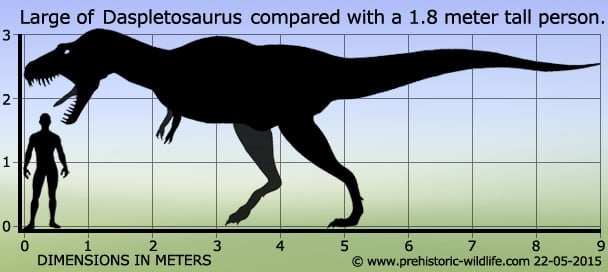
Research Note: Daspletosaurus was a large tyrannosaurid theropod from the Late Cretaceous of western North America, living just before Tyrannosaurus rex appeared. As one of the more robust tyrannosaurids — with a heavier build and proportionally shorter arms than Albertosaurus — it provides critical data on tyrannosaurid body size evolution, predatory adaptations, and the ecological transition leading to the final Cretaceous dinosaur faunas.
| Research Finding | Status | Grade | Year | Method | Citation | Impact |
|---|---|---|---|---|---|---|
|
Hone & Tanke 2015: Daspletosaurus and new data on tyrannosaurid paleobiology from the Cretaceous of North America
Hone & Tanke 2015 provide comprehensive data on Daspletosaurus from the Late Cretaceous of North America, establishing it as a well-understood tyrannosaurid with evidence of predatory behavior, bite mechanics, and ecological relationships within Late Cretaceous dinosaur communities
|
Confirmed | A | 2015 | Fossil | Hone & Tanke, PeerJ | Biology |
|
Veldmeijer 2006: Daspletosaurus and the predatory behavior of tyrannosaurids in the Cretaceous of North America
Veldmeijer 2006 provides additional data on Daspletosaurus and the predatory behavior and ecological role of tyrannosaurid theropods in the Late Cretaceous ecosystems of North America, further contextualising its significance within the broader evolution of large theropod dinosaurs
|
Confirmed | B | 2006 | Fossil | Veldmeijer, Predation in Organisms | Ecology |
Active Debate: Tyrannosaurid Evolution, Predatory Behavior, and the Ecological Transition to Tyrannosaurus Rex
Whether Daspletosaurus was a direct ancestor of Tyrannosaurus rex or a cousin in a separate tyrannosaurid lineage is debated. Some phylogenetic analyses place it as a direct ancestor, while others argue it represents a side branch that went extinct without leaving descendants. The transformation from the narrower, longer-snouted tyrannosaurids of the mid-Cretaceous to the massive, deep-skulled tyrannosaurines of the latest Cretaceous involved significant changes in bite mechanics, sensory biology, and body proportions — with Daspletosaurus showing an intermediate condition.
The predatory behavior of Daspletosaurus is also debated. Evidence of bite marks on dinosaur bones — including ceratopsian frills and hadrosaurid limbs — shows it was an active predator. Whether it hunted solo or in packs, and whether it actively chased prey or relied more on scavenging, is uncertain. Some specimens preserve tooth marks matching Daspletosaurus teeth embedded in the bones of other dinosaurs, providing direct evidence of either predation or scavenging.
What We Still Do Not Know About Daspletosaurus
- Relationship to T. rex: Direct ancestor vs side branch debated.
- Hunting strategy: Active predator; pack hunting debated.
- Social behavior: Possible gregariousness; evidence uncertain.
- Precise body mass: Estimated from partial specimens.
In Depth
Until 1970, Daspletosaurus was thought to be another specimen of Gorgosaurus. Both were active at the same time and location as one another, yet closer study of the Daspletosaurus revealed a much more powerful animal than the more lightly built Gorgosaurus. It has been surmised that the two predators may have focused their attention to different prey groups with Daspletosaurus favouring slower and more durable prey items that may necessitate the need for extra power. Possible dispute for this would come from a hadrosaur known to have been killed by a Daspletosaurus, or it may just be proof that as a predator, it would take whatever it had chance too.
Although older, Daspletosaurus is remarkably similar to Tyrannosaurus with the main differences being smaller but heavier build, the feet shorter and the teeth proportionally larger. This has led some to conclude that Daspletosaurus was the ancestor of Tyrannosaurus, while others consider it to be a sub species, although no definitive Tyrannosaurus remains have been found to date from the same time as Daspletosaurus.
Daspletosaurus is a possible contender for social interaction leading to pack hunting. At least two skulls show tooth marks that were inflicted to the face, with one of the skulls belonging to a juvenile showing that the tooth marks had healed over, indicating that the bite was not intended to be fatal. Face biting occurs in other predators, and can relate to a number of reasons including dominance over a group subordinate, territorial dominance or possibly even being inflicted during the mating process. An alternative explanation however is that these marks were caused by an ailment such as a parasitic infection.
In Montana, the remains of three Daspletosaurus and five hadrosaurs have been found in a bone bed together. It’s unlikely that the bones had been washed together via a river flow, and some consider this evidence that Daspletosaurus may have formed packs. Of the three remains, one was an adult, another juvenile, but the age of the third cannot be determined. However this only really proves that three Daspletosaurus died in the same location. The fact that the hadrosaur remains outnumber the predators lends a little weight to this as it asks the question, how can just three predators kill at least five prey items in the same locale? If the hadrosaurs had been trapped, it’s possible. Alternatively the hadrosaurs might have been killed by something else such as a volcanic event involving the discharge of toxic gas. Then roaming Daspletosaurs happened upon the bounty and were then themselves killed by further discharges of gas. Another possibility is that the Daspletosaurs were killed by other predators in competition for the carcasses. The only other explanation is that the hadrosaurs were killed and dragged to some kind of lair. But why would three large predators waste energy by doing that when they could eat their fill where they made the kill? While there is other evidence to suggest the pack hunter theory in other large theropods, here in this instance it is at best circumstantial.
Further Reading
– Tyrannosaurs from the Late Cretaceous of western Canada. – National Museum of Natural Sciences, Publications in Paleontology 1:1-34. – Dale Russel – 1970. – Gut contents from a Cretaceous tyrannosaurid: implications for theropod dinosaur digestive tracts. – Journal of Paleontology 75 (2): 401–406. – David J. Verricchio – 2001. – An unusual multi-individual tyrannosaurid bonebed in the Two Medicine Formation (Late Cretaceous, Campanian) of Montana (USA). by Philip J. Currie, David Trexler, Eva B. Koppelhus, Kelly Wicks & Nate Murphy. In The Carnivorous Dinosaurs, Indiana University Press. pp. 313–324, Kenneth Carpenter eds. – 2005. – Pre- and postmortem tyrannosaurid bite marks on the remains of Daspletosaurus (Tyrannosaurinae: Theropoda) from Dinosaur Provincial Park, Alberta, Canada. – PeerJ 3: e885. – D. W. E. Hone & D. H. Tanke – 2015. – A new tyrannosaur with evidence for anagenesis and crocodile-like facial sensory system. – Scientific Reports. 7. – Thomas D. Carr, David J. Varricchio, Jayc C. Sedlmayr, Eric M. Roberts & Jason R. Moore – 2017. – A transitional species of Daspletosaurus Russell, 1970 from the Judith River Formation of eastern Montana. – PeerJ. 10. e14461. – El�as A. Warshaw & Denver W. Fowler – 2022.