Batyrosaurus

In Depth        Batyrosaurus has been described as a basal hadrosauroid,‭ ‬the group of ornithopod dinosaurs that would give rise to the more derived hadrosaurids such as Edmontosaurus and Saurolophus towards the late Cretaceous.‭ ‬Compared to other hadrosauroids,‭ ‬the describers considered Batyrosaurus to be more advanced than Altirhinus,‭ ‬but more primitive than Probactrosaurus.        In life Batyrosaurus … Read more
Titanoceratops

In Depth        Initially thought to represent a large Pentaceratops individual,‭ ‬Titanoceratops was declared its own genera after further study found the material to belong to a new,‭ ‬although still very similar,‭ ‬ceratopsian dinosaur.‭ ‬The large size of Titanoceratops was the inspiration for the new genera name,‭ ‬with the species name T.‭ ‬ouranos derived from the … Read more

Dacentrurus

In Depth        Dacentrurus was originally named Omosaurus armatus in‭ ‬1875‭ ‬by the famous British palaeontologist Richard Owen,‭ ‬however the genus name of Omosaurus was already used to name another animal.‭ ‬This led to the‭ ‬1902‭ ‬renaming by Frederic Lucas,‭ ‬although the species name was still retained in creating the type species of the new genus,‭ … Read more

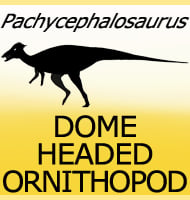
Pachycephalosaurus

pachycephalosaurus

In Depth        Once again one of the most famous dinosaurs of all time is actually‭ ‬represented by some of the most incomplete fossil material.‭ ‬ To date Pachycephalosaurus is only represented by skull material‭; ‬the actual appearance of the body so often seen in restorations is actually based upon the common form seen in more … Read more

Crichtonpelta

In Depth        Crichtonpelta was originally named as a second species of the ankylosaur Crichtonsaurus, however in 2014 the holotype skull of this species was re-described as distinct genus, making the species become a genus. Both Crichtonpelta and Crichtonsaurus were named in memory of Michael Crichton, the world famous novelist who in palaeontoligcal circles is best … Read more

Bagaceratops

In Depth        A relative of the world famous Protoceratops,‭ ‬Bagaceratops is unusual in that it is more primitive,‭ ‬yet appeared later.‭ ‬Bagaceratops seems to have been like other small ceratopsids of its kind,‭ ‬though most of the post cranial skeleton is still unknown.‭ ‬Bagaceratops would have cropped plants with its beak while also keeping an … Read more

Ferganocephale

In Depth        Ferganocephale is a dinosaur tooth taxon that might represent one of the earliest appearances of a pachycephalosaurid dinosaur.‭ ‬However,‭ ‬some researchers consider the teeth attributed to Ferganocephale to not be diagnostic enough to represent a new genus,‭ ‬and prefer to treat it as a Nomen dubium.‭ ‬Indeed,‭ ‬this is a common interpretation of … Read more

Gryphoceratops

In Depth        Gryphoceratops is something of an enigma since while it seems to be one of the oldest leptoceratopsids it also appears to have been one of the most advanced.‭ ‬Additionally while the type specimen is only that of a right lower jaw,‭ ‬Gryphoceratops may actually be the smallest leptoceratopsid.‭ ‬Another leptoceratopsid called Unescoceratops was … Read more

Cedarpelta

In Depth        Cedarpelta is not a particularly famous ankylosaurid dinosaur,‭ ‬and it does not have a huge amount of fossils attributed to it.‭ ‬However it was the first ankylosaurid genera where a skull was found disarticulated‭ (‬broken up during fossilisation‭)‬.‭ ‬This might initially sound like a bad thing,‭ ‬but usually ankylosaurid skulls are found articulated,‭ … Read more

Amtocephale

In Depth        The annoying thing about Amtocephale is that it is yet another pachycephalosaur genus that is known only from skull material,‭ ‬specifically the thick dome.‭ ‬The exciting thing about Amtocephale however is that at the time of its discovery it represents what might be the oldest known pachycephalosaur genus. Further Reading -‭ ‬A new … Read more