Probactrosaurus

In Depth        Sometimes dubbed the‭ ‘‬Asian Iguanodon‭’‬,‭ ‬Probactrosaurus is no way near as well-known as its older and far more famous relative‭ (‬which was actually the second dinosaur genus named,‭ ‬and the first one‭ ‬named‭ ‬that ate plants‭)‬.‭ ‬At roughly five and a half meters in length Probactrosaurus was actually quite small when compared to … Read more
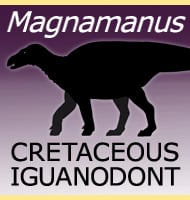
Magnamanus

magnamanus

In Depth        Magnamanus is a genus of iguanodont dinosaur that lived in Spain during‭ ‬the early Cretaceous.‭ ‬The name Magnamanus means‭ ‘‬large hand‭’‬,‭ ‬a reference to the enlarged well developed hands that this dinosaur genus adapted,‭ ‬notably more so than other known iguanodonts.‭ ‬The first individual of Magnamanus was at the time of its naming … Read more

Talenkauen

Talenkauen: Research Database Iguanodontia (Ornithischia) · Late Cretaceous (~70 MYA) · South America — Argentina (Cerro del Pueblo Formation)   Research Note: Talenkauen was an iguanodontian ornithischian from the Late Cretaceous Cerro del Pueblo Formation of Argentina. It provides data on ornithischian diversity in Late Cretaceous South America.   Research Finding Status Grade Year Method … Read more

Edmontosaurus

Edmontosaurus: Research Database Hadrosauridae (Ornithischia) · Late Cretaceous (~73–66 MYA) · North America — USA, Canada (Hell Creek, Prince Creek, Scollard Formations)   Research Note: Edmontosaurus was one of the most abundant and widespread hadrosaurid dinosaurs in Late Cretaceous North America, with fossils known from Alaska to Colorado to New Jersey. As a non-crested hadrosaurid … Read more

Iyuku

In Depth        In the closing years of the twentieth century a bone bed containing the remains of at least twenty-seven juvenile dinosaurs was excavated in South Africa.‭ ‬The‭ ‬2022‭ ‬study describing the genus‭ (‬Forster et al.‭) ‬considers these juveniles to represent everything from hatchlings to subadults,‭ ‬Possibly located at a nesting site.‭        The‭ ‬2022‭ ‬description … Read more

Osmakasaurus

In Depth        Originally named as a species of Camptosaurus‭ ‬1909‭ (‬Gilmore‭)‬,‭ ‬and then later Planicoxa in‭ ‬2008‭ (‬Carpenter‭ & ‬Wilson‭)‬,‭ ‬Osmakasaurus was established as a new genus for partial post cranial remains that establish this genus.‭ ‬The species name‭ ‘‬depressus‭’ ‬has been retained to create the type species,‭ ‬which is standard procedure when naming a … Read more

Notohypsilophodon

In Depth        Notohypsilophodon is a genus of small ornithopod dinosaur that lived in South America during the late Cretaceous.‭ ‬Notohypsilophodon is so named based upon a superficial similarity to the genus Hypsilophodon while also recognising the more southern occurrence of this individual.‭ ‬Notohypsilophodon is so far only known from the partial remains of a juvenile,‭ … Read more

Iguanacolossus

In Depth        Iguanacolossus acquired its name from its similarity to another dinosaur named Iguanodon.‭ ‬Although Iguanacolossus might not actually have been any bigger than the largest examples of Iguanodon,‭ ‬it might still have been the largest ornithopod plant eating dinosaur alive in North America at this stage of the Cretaceous,‭ ‬with the only plant‭ ‬eaters … Read more

Hypselospinus

Hypselospinus: Research Database Iguanodontia (Ornithischia) · Early Cretaceous (~140–130 MYA) · Europe — England (Wadhurst Clay Formation)   Research Note: Hypselospinus was an iguanodontian ornithischian from the Early Cretaceous Wadhurst Clay Formation of England. As a member of Iguanodontia, it provides important data on ornithischian diversity in the European Cretaceous.   Research Finding Status Grade … Read more

Siamodon

In Depth        Although named from only a maxilla and tooth,‭ ‬the remains of this dinosaur are still complete enough to confidently identify it as an iguanodont.‭ ‬In life Siamodon would have been a medium to large sized ornithopod dinosaur that would have been primarily quadrupedal,‭ ‬but also occasionally bipedal.‭ ‬Although identified as being separate,‭ ‬Siamodon … Read more