Anchitherium

In Depth        Anchitherium was a genus of three toed prehistoric horse that was a browser of plants rather than a grazer of grass,‭ ‬something that is most easily revealed by the teeth that have much lower crowns than those of known grazing horses.‭ ‬This is also why Anchitherium disappeared without leaving any modern descendants because … Read more
Planicoxa

In Depth        A medium sized iguanodontid,‭ ‬dinosaur from the early Cretaceous of the USA,‭ ‬Planicoxa is established upon the partial remains of several individuals.‭ ‬As an iguanodontid,‭ ‬Planicoxa would have been a primarily quadrupedal dinosaur,‭ ‬though one with the capability to rear up and walk on just its hind legs when it needed to.‭ ‬Planicoxa … Read more

Peltobatrachus

In Depth        Peltobatrachus had an arrangement of bony armour plates that ran down the length of its body similar to an armadillo. Although it lived on the land, Peltobatrachus probably still had to return to water to lay its eggs like other amphibians. Further Reading Further reading- A new armoured amphibian from the Upper Permian … Read more

Turanoceratops

In Depth        There is some confusion about Turanoceratops,‭ ‬given that we know that it was a ceratopsian dinosaur,‭ ‬but not all palaeontologists agree upon exactly what kind.‭ ‬Papers published by Sues and Averianov in‭ ‬2009‭ ‬support the idea that Turanoceratops was a transitional form that linked primitive ceratopsians of the Ceratopsoidea,‭ ‬with the more advanced … Read more

Russellosaurus

In Depth        Russellosaurus represents a primitive mosasaur,‭ ‬marine reptiles that would go on to achieve a variety of sizes and specialisations that would see them becoming the dominant predators of the late Cretaceous seas.‭ ‬Russelosaurus itself displays a number of features which are diagnostic of more than one mosasaur group,‭ ‬something that suggests that these … Read more

Estemmenosuchus

In Depth        Although other herbivorous therapsids like Styracocephalus also had head crests,‭ ‬Estemmenosuchus had by far the most elaborate head ornamentation.‭ ‬These crests varied between the two species,‭ ‬but superficially the head ornamentation resembled short deer antlers.‭ ‬The horns of Estemmenosuchus grow upwards from the frontal skull bones and seem to have primarily been display … Read more

Iranotherium

In Depth        Iranotherium was a genus of rhinoceros that was once fairly widespread across central Asia.‭ ‬Individuals of Iranotherium were between three and four meters long,‭ ‬though as with other known kinds of rhinoceroses,‭ ‬the males would have been larger than females.‭ ‬The largest males could approach sizes up to four meters long.‭ ‬The disappearance … Read more

Angolachelys

In Depth        At the time of its description,‭ ‬Angolachelys represents the oldest known genus of eucryptodire from Africa.‭ ‬Angolachelys means‭ ‘‬Angola turtle‭’ ‬after the country where it was discovered.‭ ‬The type species‭ ‬name A.‭ ‬mbaxi is derived from the word Mbaxi which means turtle in the Angolan Nyaneka−Nkumbi and Kimbundo languages        Angolachelys was found in … Read more

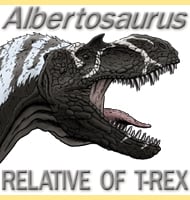
Albertosaurus

albertosaurus

In Depth        The first remains of Albertosaurus were recovered from the Horseshoe Canyon Formation in‭ ‬1884,‭ ‬and these were the type specimen along with a smaller skull and some of the post crania.‭ ‬However Albertosaurus was not yet identified and when these parts were studied in‭ ‬1892‭ ‬by Edward Drinker Cope,‭ ‬he assigned them to … Read more

Borealestes

In Depth        Borealestes is a genus of docodont therapsid that lived in Scotland during the Permian.‭ ‬A former species B.‭ ‬mussettae,‭ ‬has now been given its own genus,‭ ‬Dobunnodon. Further reading -‭ ‬The first Jurassic mammal from Scotland.‭ ‬-‭ ‬Journal of the Geological Society‭ ‬128:119-125.‭ ‬-‭ ‬M.‭ ‬Waldman‭ & ‬R.‭ ‬J.‭ ‬G.‭ ‬Savage‭ ‬-‭ ‬1972. … Read more