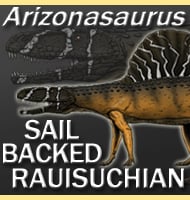
Arizonasaurus

arizonasaurus

In Depth        Arizonasaurus has enjoyed a lot of popularity since the discovery of a far more complete specimen in‭ ‬2002.‭ ‬Before this Arizonasaurus was only known from very partial remains‭ ‬that were only diagnostic enough to classify it as a rauisuchian,‭ ‬reptiles that were the dominant predators of the Triassic while the early dinosaurs were … Read more

Platysomus

In Depth        Platysomus had a very deep body with a reduced tail and quite small pectoral fins,‭ ‬all indicators that fish of this genus were slow swimmers.‭ ‬Despite this,‭ ‬Platysomus was a highly successful genus,‭ ‬a statement that is easily backed up just by looking at the broad temporal and geographic ranges of the known … Read more

Alamosaurus

In Depth        The one‭ ‘‬fact‭’ ‬that is often presented for Alamosaurus is that it is named after the Alamo,‭ ‬the famous mission in San Antonia that was the site for one of the most important battles in the Texas Revolution.‭ ‬However this is completely false and the truth of the matter is that the first … Read more

Pellegrinisaurus

In Depth        Pellegrinisaurus is a genus of titanosaur that lived in South America during the late cretaceous.‭ ‬So far most of the fossils attributed to Pellegrinisaurus are vertebra,‭ ‬however these are mostly from the tail with only a small number of back vertebrae known.‭ ‬This makes an exact size estimate impossible to establish because we … Read more

Dissopsalis

In Depth        Although still only known from a few scattered and incomplete fossils,‭ ‬Dissopsalis stands out from other creodonts by being one of the last to live.‭ ‬The earliest species was D.‭ ‬pyroclasticus from Kenya,‭ ‬but it is the type species of D.‭ ‬carnifex from Asia that confirms is position as a late surviving creodont.‭ … Read more

Lusotitan

In Depth        The first fossils of Lusotitan were found in‭ ‬1947,‭ ‬and named in‭ ‬1957‭ ‬as a species of Brachiosaurus by Albert-F�lix de Lapparent and Georges Zbyszewski.‭ ‬In‭ ‬2003‭ ‬Oct�vio Mateus‭ & ‬Miguel Telles Antunes renamed the fossils as Lusotitan atalaiensis on the basis that the differences were greater than what was to be expected … Read more

Larachelus

In Depth        Larachelus was a pan-cryptodiran turtle,‭ ‬and the appearance of the genus‭ ‬in early Cretaceous era rocks of Spain has helped reveal the range and diversity pan-cryptodiran turtles. Further Reading -‭ ‬Larachelus morla,‭ ‬gen.‭ ‬Et sp.‭ ‬Nov.,‭ ‬a new member of the little-known European Early Cretaceous record of stem cryptodiran turtles‭ ‬-‭ ‬Journal of … Read more

Equus simplicidens a.k.a.‭ ‬American zebra,‭ ‬Hagerman horse

In Depth Further Reading – A contribution to the vertebrate paleontology of Texas. – Proceedings of the American Philosophical Society 30(137):123-131 – E. D. Cope – 1892.892. -‭ ‬A new Pliocene horse from Idaho,‭ ‬James W.‭ ‬Gidley‭ ‬-‭ ‬1930

Belantsea

In Depth        Belantsea would essentially‭ ‬have‭ ‬been the Carboniferous equivalent of a parrotfish.‭ ‬The body was bulky with strong muscular fins,‭ ‬and an underdeveloped tail which all indicate a preference for manoeuvrability over speed.‭ ‬The teeth are triangular and tightly packed to form a dental arrangement similar to a beak which would have easily‭ ‬broken … Read more

Amargatitanis

In Depth        An early Cretaceous sauropod dinosaur from South America,‭ ‬the precise size of Amargatitanis is hard to establish due to lack of remains.‭ ‬The name Amargatitanis is a reference to its discovery in the La Amarga Formation,‭ ‬and its titanosaurian lineage.‭ ‬Other sauropods known from the La Amarga Formation include Zapalasaurus and the similarly … Read more