Nochnitsa

In Depth        With a skull a little over eight centimetres long Nochnitsa is one of the smallest known grogonopsian therapsids known.‭ ‬Whereas the larger gorgonopsids were apex predators,‭ ‬Nochnitsa may have lived more like a modern day fox,‭ ‬hunting smaller creatures while evading the more dangerous ones. Further Reading -‭ ‬Gorgonopsian therapsids‭ (‬Nochnitsa gen.‭ ‬nov.‭ … Read more

Voay

In Depth        The remains of the crocodile Voay were first described as a species of Crocodylus‭ (‬C.‭ ‬robustus‭) ‬back in‭ ‬1872‭ ‬by Grandidier and Vaillant,‭ ‬however later study found that the remains were nearer to the dwarf crocodile Osteolaemus,‭ ‬although not close enough to be included with this genus either.‭ ‬For this reason C.‭ ‬A.‭ … Read more

Isisfordia

isisfordia

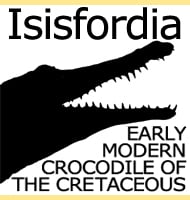
In Depth        Although crocodiles and indeed crocodile like reptiles have existed since the Triassic, Isisfordia is considered to represent an early member of the group that make up modern crocodiles. This is evidenced by the ball and socket type connection of the vertebrae, and the presence of a secondary palate that allowed Isisfordia to breathe … Read more

Narindasaurus

In Depth        Narindasaurus is a genus of sauropod dinosaur that lived in Madagascar during the mid Jurassic.‭ ‬Fossils of this dinosaur were first discovered in‭ ‬1906,‭ ‬but were not given their own distinct genus till‭ ‬2020.‭ ‬Before that time they had still been studied,‭ ‬with growth ring analysis suggesting that this sauropod dinosaur did not … Read more

Westlothiana

In Depth        Westlothiana has caused some confusion among researchers as to whether it should be called reptile or amphibian.‭ ‬While it does have some reptilian features such as no otic notch and unfused ankle bones,‭ ‬the main skeletal structure has features that are reminiscent of the early terrestrial amphibians.‭ ‬This has led to the term‭ … Read more

Anasazisaurus

In Depth        Anasazisaurus is currently only known from a single skull,‭ ‬but one that has a flange of bone rising from the top of its snout.‭ ‬Because this crest is solid,‭ ‬Anasazisaurus has been identified as a saurolophine hadrosaurid.‭ ‬The skull of Anasazisaurus was once attributed to the genus Kritosaurus,‭ ‬but because the skull contains … Read more

Atrociraptor

In Depth        Atrociraptor has been described from very incomplete remains,‭ ‬but two clear observations can be made about this dinosaur.‭ ‬One is that the snout appears to be both deeper and shorter than most other dromaeosaurs,‭ ‬something that could indicate a strong bite due to larger muscles and the outer teeth being placed closer to … Read more

Asiaceratops

In Depth        Very little‭ ‬is known about Asiaceratops because the currently known fossils of this dinosaur are so fragmentary that some researchers have even questioned the validity of the genus. Further Reading -‭ [‬Mesozoic ceratopsian dinosaurs and crocodiles of central Asia‭]‬.‭ ‬In:‭ ‬Bogdanova and Khozatskii‭ (‬eds.‭)‬,‭ ‬Theoretical and Applied Aspects of Modern Palaeontology pp‭ ‬144-154.‭ … Read more

Anomocephalus

In Depth        Anomocephalus is considered to be a very basal anomodont,‭ ‬and one observation more than any other proves this‭; ‬Anomocephalus had a full set of teeth in both jaws.‭ ‬The dicynodont descendants of creatures like Anomocephalus would go on to have just two large tusks,‭ ‬and in a few cases,‭ ‬no teeth at all.‭ … Read more

Samrukia

In Depth        Samrukia is a genus that illustrated the dangers of naming prehistoric creatures by only partial remains.‭ ‬The original describers of Samrukia‭ (‬Naish et al.‭) ‬had a single jawbone that was first thought to belong to an ovirapotosaurian theropod dinosaur,‭ ‬but then later thought to belong to a bird.‭ ‬This raised a lot of … Read more