Condorchelys

In Depth        Condorchelys is a genus of turtle that lived in South America during the Jurassic. Further Reading -‭ ‬A new,‭ ‬nearly complete stem turtle from the Jurassic of South America with implications for turtle evolution.‭ ‬-‭ ‬Biology Letters‭ ‬4‭(‬3‭)‬:286-289.‭ ‬-‭ ‬J.‭ ‬Sterli‭ ‬-‭ ‬2008.

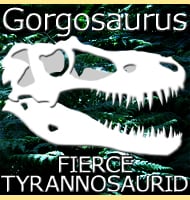
Gorgosaurus

gorgosaurus

In Depth        Gorgosaurus had the same basic body plan of all tyrannosaurids with a large head on an s-shaped neck,‭ ‬small arms and bipedal stance.‭ ‬With around sixty teeth in its mouth‭ (‬there is some variance between specimens‭) ‬Gorgosaurus shared a common trait with other tyrannosaurids of its size,‭ ‬as the larger the tyrannosaurids go … Read more

Attockicetus

In Depth        Attockicetus was a remingtonocetid whale that lived in Pakistan during the Eocene.‭ ‬The known partial remains of the genus make reconstructing Attockicetus difficult,‭ ‬however the genus is expected to have been similar to its relatives Remingtonocetus,‭ ‬Andrewsiphius and Kutchicetus. Further Reading -‭ ‬Attockicetus praecursor,‭ ‬a new remingtonocetid cetacean from marine Eocene sediments of … Read more

Megaladapis a.k.a.‭ ‬Koala Lemur

In Depth Further Reading – On Megaladapis madagascariensis, an Extinct Gigantic Lemuroid from Madagascar; with Remarks on the Associated Fauna, and on Its Geological Age. – Philosophical Transactions of the Royal Society B: Biological Sciences. 185: 15–38. – C. I. F. major -1894. – Extinct Mammalia from Madagascar. I. Megaladapis insignis. – Philosophical Transactions of … Read more

Atlantochelys

In Depth        Atlantochelys was first named in‭ ‬1849‭ ‬and based upon the description of half a humerus‭ (‬analogous to your upper arm bone‭)‬.‭ ‬For well over one hundred and fifty years that was it,‭ ‬but then in‭ ‬2012‭ ‬the missing half of this bone was actually matched up to the original specimen.‭ ‬Although Atlantochelys may … Read more

Dinodontosaurus

In Depth        With a length approaching two hundred and forty centimetres long, Dinodontosaurus was certainly large for a dicynodont, though relative genera such as Placerias and Kannemeyeria were even larger still. Dinodontosaurus are quite common, especially in South America where the majority of known fossils come from. The name Dinodontosaurus means ‘terrible toothed lizard’, and … Read more

Teratosaurus

In Depth        Teratosaurus was among the first rauisuchians to ever be named,‭ ‬though in the early days of the genus classification,‭ ‬it was actually thought to be a dinosaur.‭ ‬The holotype specimen of Teratosaurus,‭ ‬a partial right maxilla with teeth,‭ ‬was first found near Stuttgart,‭ ‬Germany in the year‭ ‬1860.‭ ‬The holotype found its way … Read more

Puentemys

In Depth        Closely related to the genus Foxemys,‭ ‬Puentemys is recognised as the largest known bothremydid turtle in the fossil record with a shell length of just over one and a half meters.‭ ‬Bothremydid turtles like Puentemys are a special group of the Pleurodira,‭ ‬a group more popularly known as‭ ‘‬side-necked turtles‭’‬.‭ ‬This is because … Read more

Chialingosaurus

In Depth        So far only known from a partial skeleton,‭ ‬Chialingosaurus was still one of the first and hence most important stegosaur discoveries to take place in Asia.‭ ‬At up to four meters long it seems to have been small but comparable in size to Chungkingosaurus that is also known from the Shaximiao Formation.‭ ‬However … Read more

Brasilodon

In Depth        Brasilodon is a genus of very small cynodont that lived in Brazil during the late Triassic.‭ ‬Brasilodon was named alongside another similar cynodont called Brasilitherium. Further Reading -‭ ‬The sister group of mammals:‭ ‬small cynodonts from the Late Triassic of southern Brazil.‭ ‬-‭ ‬Revista Brasileira de Paleontolog�a‭ ‬5:5-27.‭ ‬-‭ ‬J.‭ ‬F.‭ ‬Bonaparte,‭ ‬A.‭ … Read more