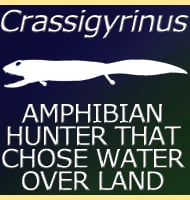
Crassigyrinus

crassigyrinus

In Depth        An interesting specimen of an early amphibian as it appears to have completely abandoned terrestrial life in favour of an aquatic lifestyle.‭ ‬Its limbs,‭ ‬especially those at the front,‭ ‬were greatly reduced in size and would have been no use for land locomotion.‭ ‬They would have still served as rudders ‬and may have … Read more

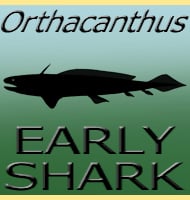
Orthacanthus

orthacanthus

In Depth        Not only was Orthacanthus very similar to the smaller Xenacanthus,‭ ‬it also has a similar temporal range in the fossil record.‭ ‬The two sharks probably coexisted with only the minimum of competition between the two.‭ ‬This is because at only one meter long,‭ ‬Xenacanthus could operate in waters that were too small or … Read more

Yacarerani

In Depth        Yacarerani is a small notouchian crocodilomorph that lived in South America during the early stages of the Late Cretaceous.‭ ‬Yacarerani has a highly specialised dentition with the two most forward incisors in the lower jaw almost pointing directly forwards.‭ ‬The upper fore teeth also protrude forwards and these teeth may have been for … Read more

Narambuenatitan

In Depth        Narambuenatitan was a fairly small genus titanosaur that lived in South America during‭ ‬the Late Cretaceous.‭ ‬Narambuenatitan has also been noted as being similar to the genus Epachthosaurus,‭ ‬and the two are included within the Lithostrotia titanosaurs. Further Reading -‭ ‬A new titanosaur sauropod dinosaur from the Upper Cretaceous of North Patagonia,‭ ‬Argentina.‭ … Read more

Boreonykus

In Depth        Boreonykus is a genus of dromaeosaurid dinosaur that lived in Canada during the late Cretaceous. Further Reading -‭ ‬A high-latitude dromaeosaurid,‭ ‬Boreonykus certekorum,‭ ‬gen.‭ ‬et sp.‭ ‬nov.‭ (‬Theropoda‭)‬,‭ ‬from the upper Campanian Wapiti Formation,‭ ‬west-central Alberta.‭ ‬-‭ ‬Journal of Vertebrate Paleontology e1034359.‭ ‬-‭ ‬P.‭ ‬R.‭ ‬Bell‭ & ‬P.‭ ‬J.‭ ‬Currie‭ ‬-‭ ‬2015.

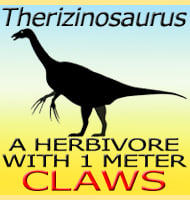
Therizinosaurus

therizinosaurus

In Depth        What makes Therizinosaurus and others from its group stand out from other dinosaurs are the huge claws that are on the end of its fingers.‭ ‬In Therizinosaurus these claws reached up to one meter long,‭ ‬and there purpose has three main theories.‭ ‬The first is for display,‭ ‬with the larger claws being indicative … Read more

Afrodon

In Depth        Afrodon was a small eutherian mammal that seems to have been spread at least across Western Europe to the Western tip of North Africa.‭ ‬Add into account the broad temporal range of this mammal,‭ ‬and it seems that Afrodon was a very successful little mammal. Further Reading -‭ ‬Afrodon chleuhi nov.‭ ‬gen.,‭ ‬nov.‭ … Read more

Kaijutitan

In Depth        Kaijutitan is a genus of titanosaur that lived in South America during the late Cretaceous.‭ ‬The name‭ ‬Kaijutitan is derived from the Japanese word‭ ‘‬Kaiju‭’ ‬which means‭ ‘‬monster‭’‬. Further Reading -‭ ‬A new giant basal titanosaur sauropod in the Upper Cretaceous‭ (‬Coniacian‭) ‬of the Neuqu�n Basin,‭ ‬Argentina.‭ ‬-‭ ‬Cretaceous Research‭ ‬100:61-81.‭ ‬-‭ ‬L.‭ … Read more

Albertonectes

In Depth        Albertonectes is one of the best preserved elasmosaurid plesiosaurs to be discovered in Canada,‭ ‬and has a total of‭ ‬76‭ ‬cervical‭ (‬neck‭) ‬vertebrae‭ ‬.‭ ‬Elasmosaurid pesiosaurs like Albertonectes are noted for having their long necks that are proportionately much longer than earlier plesiosaur types.‭ ‬This would have been a specialist feeding adaptation allowing … Read more

Alexandronectes

In Depth        Described from a single partially preserved skull,‭ ‬Alexandronectes was an elasmosaurid plesiosaur that swam in the waters around what is now New Zealand during the late Cretaceous.‭ ‬These were dangerous waters as fossils of large mosasaurs such as Taniwhasaurus are also known from the same formation as Alexandronectes,‭ ‬and these predators were certainly … Read more