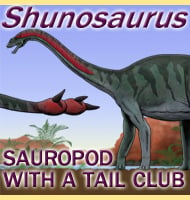
Shunosaurus

shunosaurus

In Depth        The large number of well-preserved Shunosaurus individuals that have been recovered has revealed much about Shunosaurus making it perhaps the most complete sauropod genus known. This material has also allowed palaeontologist to confirm as well as speculate upon new theories for other sauropods that are not as well represented as Shunosaurus. However, despite … Read more
Saltopus

In Depth        Saltopus has had a murky taxonomic history with some researchers crediting it with being an early theropod dinosaur,‭ ‬while others insist that it was an advanced archosaur similar to Marasuchus.‭ ‬Currently most palaeontologists agree that Saltopus is most probably a dinosauriform,‭ ‬more advanced than an archosaur,‭ ‬but not quite a dinosaur.‭ ‬One argument … Read more

Dicraeosaurus

dicraeosaurus

In Depth        Dicraeosaurus was relatively small by sauropod standards,‭ ‬but was still a bit larger than Amargasaurus,‭ ‬so far the only other known member of its group.‭ ‬Dicraeosaurus sported a double row of spines down its back that‭ ‬are‭ ‬similar to those seen on the back of Amargasaurus.‭ ‬We cannot be certain what these spike … Read more

Plesiohadros

In Depth        Plesiohadros is a genus of hadrosaur that lived in Asia during the late Cretaceous. Further Reading -‭ ‬A new hadrosaurid‭ (‬Plesiohadros djadokhtaensis‭) ‬from the Late Cretaceous Djadokhtan Fauna of southern Mongolia.‭ ‬-‭ ‬Hadrosaurs‭ ‬108-135.‭ ‬-‭ ‬K.‭ ‬Tsogtbaatar,‭ ‬D.‭ ‬B.‭ ‬Weishampel,‭ ‬D.‭ ‬C.‭ ‬Evans‭ & ‬M.‭ ‬Watabe‭ ‬-‭ ‬2014.

Palmulasaurus

In Depth        Palmulasaurus was initially named as Palmula when first described in‭ ‬2007,‭ ‬but it was soon realised that Palmula was actually preoccupied by a genus of foraminifer‭ (‬an amoeboid protist‭)‬,‭ ‬hence the later addition of the Ancient Greek‭ ‘‬saurus‭’ ‬which means‭ ‘‬lizard‭’‬.‭ ‬In‭ ‬2007‭ ‬Albright,‭ ‬Gillette and Titus also named of polycotylid plesiosaur from … Read more

Archelon

archelon

In Depth        Although a turtle,‭ ‬Archelon has become a staple species that appears in almost every book about dinosaurs and other prehistoric animals.‭ ‬This almost mandatory inclusion comes from the fact that Archelon is the largest turtle ever known to exist‭ ‬and it lived at the end of the Cretaceous.‭ ‬For the most part dinosaurs … Read more

Eocasea

In Depth        Eocasea is a very primitive genus of caseid synapsid that lived in North America during the Carboniferous,‭ ‬hence the name which means‭ ‘‬Dawn Casea‭’‬,‭ ‬a reference to the earlier appearance of this genus compared to the type genus of the Caseidae,‭ ‬Casea.‭ ‬Most caseid genera that are currently known to us have leaf … Read more

Nuthetes

In Depth        Originally thought to be a juvenile of a species of Megalosaurus, Nuthetes was later established as a distinct genus. Today Nuthetes is thought to represent a possible dromaeosaurid dinosaur, but the key word here is ‘possible’. So far Nuthetes is only known from teeth and a fragment of jawbone, making such things as … Read more

Spathobatis

In Depth        An ancient ray,‭ ‬Spathobatis was actually similar to a guitarfish in form.‭ ‬The snout was slightly elongated which meant that it could be used to shovel through soft sediment like mud in order to uncover shellfish that had buried themselves for protection.‭ ‬Spathobatis is regarded as one of the earliest prehistoric rays,‭ ‬though … Read more

Lophorhinus

In Depth        Lophorhinus was a burnetiamorph biarmosuchian therapsid that lived in South Africa during the late Permian.‭ ‬As a burnetiamorph Lophorhinus was closer in form to the genus Burnetia than to Biarmosuchus.‭ ‬Other genera that Lophorhinus seems to be closely related to include Lobalopex and Pachydectes.        Lophorhinus had enlargeds canine teeth that were likely the … Read more