Texasetes

In Depth        Texasetes was the first armoured nodosaurid dinosaur to be named from the Paw Paw Formation of Texas.‭ ‬However a year later a second genus of nodosaur called Pawpawsaurus was named,‭ ‬though only represented by a skull.‭ ‬There has now been suggestions that these two are the same genus,‭ ‬and if proven true,‭ ‬then … Read more

Huaxiagnathus

In Depth        Huaxiagnathus is one of the larger members of the compsognathid group of dinosaurs, although it is smaller than the related Sinocalliopteryx which is also from the Yixian Formation. The fore limbs of Huaxiagnathus are proportionately larger and more developed than other related dinosaurs suggesting that they had a greater role in prey capture … Read more

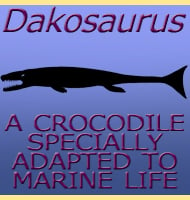
Dakosaurus

dakosaurus

In Depth        The deep skull of Dakosaurus has led to this marine reptile being nicknamed‭ ‘‬Godzilla‭’ ‬in the popular media.‭ ‬However unlike the famous Japanese daikaiju,‭ ‬Dakosaurus was actually a four to five meter long crocodile that was specially adapted for a life at sea.‭ ‬It’s tall and deep skull meant that Dakosaurus was actually … Read more

Magnirostris

In Depth        Magnirostris was a protoceratopsid dinosaur that would have been similar to the much more famous‭ ‬Protoceratops.‭ ‬Magnirostris was named after the unusually large beak that can be clearly appreciated in the holotype specimen.‭ ‬There has been suggestion that the Magnirostris holotype may in fact belong to the Bagaceratops genus.‭ ‬The thinking behind this … Read more

Glacialisaurus

In Depth        Glacialisaurus is the first genus of sauropodomorph dinosaur known from Antarctica.‭ ‬Though only known from a few hind limb bones,‭ ‬these are enough to identify Glacialisaurus as a massospondylid sauropodomorph dinosaur,‭ ‬as well as possible close relative of Lufengosaurus from China.        From the same fossil formation that the Glacialisaurus holotype remains are known … Read more

Afrovenator

In Depth        Afrovenator is one of the most complete theropod dinosaurs so far discovered in Africa,‭ ‬the harsh environmental conditions of which can quickly erode fossils exposed to the elements.‭ ‬Since this time Afrovenator has had a muddled taxonomic history with it being described as a relative of Spinosaurus,‭ ‬Eustreptospondylus,‭ ‬Dubreuillosaurus,‭ ‬Megalosaurus and even Allosaurus.‭ … Read more

Silvisaurus

In Depth        Silvisaurus is to date only known by a partial skeleton,‭ ‬and this is in a poor state of preservation that was weathered and trampled by cattle for a long time before it was discovered.‭ ‬Despite the poor state of preservation,‭ ‬Silvisaurus is considered to have been a primitive form of nodosaur that maybe … Read more

Ichthyodectes

In Depth        Like with relative genera such as Gillicus and Xiphactinus,‭ ‬Ichthyodectes would have been a key predator in the waters of the Western Interior Seaway,‭ ‬the shallow sea that submerged the central portion of North America during the Cretaceous.‭ ‬Ichthyodectes had a long body similar to that of a modern day barracuda and was … Read more

Harpagophagus

In Depth        Harpagophagus is but one of many‭ ‘‬bear dog‭’ ‬genera that lived in Europe during the Oligocene. Further Reading Further reading- Deux nouveaux carnassiers de Phosphorites du Quercy. – Annales de Paleontologie 57:117-127. – L. De Bonis – 1971.

Sinodelphys

In Depth        When described in‭ ‬2003,‭ ‬Sinodelphys was the oldest confirmed and definitive marsupial mammal.‭ ‬Sinodelphys was very small,‭ ‬only about fifteen centimetres long,‭ ‬and is thought to have lived most of its life either hidden up trees or amongst dense undergrowth well out of reach of predatory dinosaurs that would have been running around … Read more