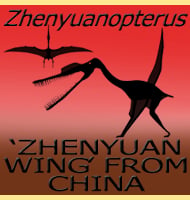
Zhenyuanopterus

zhenyuanopterus

In Depth        The jaws of Zhenyuanopterus feature long needle like teeth that protrude out of the jaws and intermesh when the mouth is closed. The largest teeth are at the front, although they get significantly smaller as they approach the nostril. Some have considered the larger teeth at the front to have been too fragile … Read more
Aquila bullockensis

In Depth Further Reading -‭ ‬A New Eagle‭ (‬Aves:‭ ‬Accipitridae‭) ‬from the Mid Miocene Bullock Creek Fauna of Northern Australia,‭ ‬P.‭ ‬Gaff‭ & ‬W.‭ ‬E.‭ ‬Boles‭ ‬-‭ ‬2010.

Segisaurus

In Depth        Segisaurus was once considered to be a very important link in the evolution of theropods because it was thought to have had solid bones instead of the hollow bones of other earlier genera such as Coelophysis.‭ ‬However a later study into the holotype remains that took place in‭ ‬2005‭ (‬Carrano,‭ ‬Hutchinson‭ & ‬Sampson‭) … Read more

Shenzhousaurus

In Depth        Along with Sinornithomimus,‭ ‬Shenzhousaurus is one of the few ornithomimosaurs that are known to have had gastroliths inside their stomachs.‭ ‬This has led to the suggestion that Shenzhousaurus had a greater leaning towards a herbivorous diet since gastroliths are usually associated with herbivorous animals.‭ ‬However it is not unknown for some predatory animals … Read more

Madtsoia

In Depth        Madtsoia is the genus that was used to name the Madtsoiidae group of prehistoric snakes that include others such as Gigantophis of North Africa to the much later Wonambi of Australia. Madtsoia is one of the older members with fossils indicating that it was active during the time of the dinosaurs. Unfortunately no … Read more

Nemegtonykus

In Depth        Nemegtonykus is a genus of alvarezsaurid dinosaur that lived in Asia during the late Cretaceous. Further Reading -‭ ‬A new alvarezsaurid dinosaur from the Nemegt Formation of Mongolia‭”‬.‭ ‬Scientific Reports.‭ ‬9‭ (‬1‭)‬.‭ ‬-‭ ‬Sungjin Lee,‭ ‬Jin-Young Park,‭ ‬Yuong-Nam Lee,‭ ‬Su-Hwan Kim,‭ ‬Junchang Lďż˝,‭ ‬Rinchen Barsbold‭ & ‬Khishigjav Tsogtbaatar‭ ‬-‭ ‬2019.

Rapaxavis

In Depth        Rapaxavis is a genus of enantiornithine bird that lived in China during the early Cretaceous. Further Reading -‭ ‬Anatomy of the Early Cretaceous bird Rapaxavis pani,‭ ‬a new species from Liaoning Province,‭ ‬China.‭ ‬-‭ ‬Journal of Vertebrate Paleontology‭ ‬29‭(‬2‭)‬:545-554.‭ ‬-‭ ‬E.‭ ‬M.‭ ‬Morschhauser,‭ ‬D.‭ ‬J.‭ ‬Varricchio,‭ ‬C.‭ ‬Gao,‭ ‬J.‭ ‬Liu,‭ ‬Z.‭ ‬Wang,‭ ‬X.‭ … Read more

Indohyus

In Depth        A relative of the better known Diacodexis,‭ ‬Indohyus has been speculated to be a member of a group of mammals that were possibly related to the mammals whose descendants would eventually go on to become the whales.‭ ‬This stems back to study of Indohyus which revealed that it had bones denser than most … Read more

Heishanobaatar

In Depth        Heishanobaatar is a genus of multituberculatan mammal that lived in China during the early Cretaceous. Further Reading -‭ ‬New multituberculate mammals from the Lower Cretaceous‭ (‬Shahai and Fuxin formations‭)‬,‭ ‬northeastern China.‭ ‬Journal of Vertebrate Paleontology‭ ‬30‭(‬5‭)‬:1501-1514.‭ ‬-‭ ‬N.‭ ‬Kusuhashi,‭ ‬Y.‭ ‬Hu,‭ ‬T.‭ ‬Setoguchi‭ & ‬H.‭ ‬Matsuoka‭ ‬-‭ ‬2010.

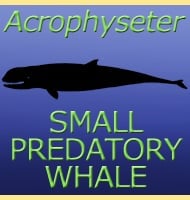
Acrophyseter

acrophyseter

In Depth        When you translate the full name of Acrophyseter deinodon into English you end‭ ‬up with‭ ‘‬acute sperm whale terrible teeth‭’‬.‭ ‬The genus part of‭ ‘‬acute sperm whale‭’ ‬is a reference to the upturned bend in the jaws,‭ ‬suggesting that Acrophyseter may have approached prey from below.‭ ‬The species name deinodon,‭ ‬or‭ ‘‬terrible teeth‭’ … Read more