In Depth
The first specimen of Acamptonectes was discovered in 1958 from the Speeton Clay Formation, but was never officially described. A second specimen from this formation was recovered in 1985. Early interpretations of Acamptonectes led to the conclusion that it was similar to Platypterygius, but a new discovery from Germany in 2003 was found to bear similarities to the 1958 material, a discovery that sparked fresh interest in the fossils. A later study that was a collaboration of all the palaeontologists involved with these specimens saw the formal creation of Acamptonectes as a valid genus, as well as realisation that it was actually more similar to ichthyosaurs like Ophthalmosaurus and Mollesaurus.
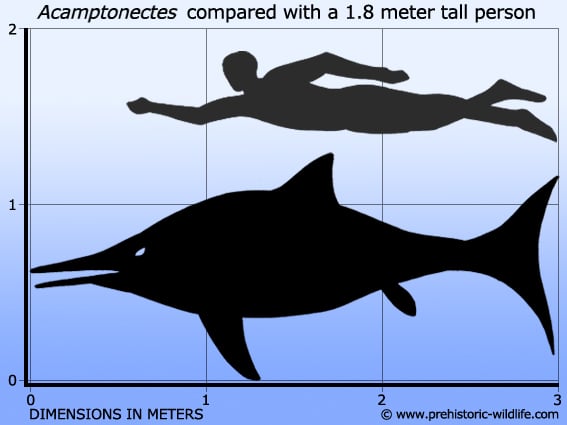
The name Acamptonectes, which means ‘rigid swimmer’, is a reference to the tightly packed cervical (neck) vertebra which means that Acamptonectes probably was not able to turn its head from side to side. Additionally the front half of the post cranial skeleton, particularly the strongly developed ribs also hint towards a very rigid forward body with the only real motion coming from the tail. This might suggest that Acamptonectes relied upon high forward speed in chasing down prey like fast swimming fish rather than trying to out manoeuvre them. This torpedo-like motion would be better suited for high speed as Acamptonectes would not experience unnecessary drag caused by the side to side swaying of a body in motion. Additional developments to reduce water resistance are the shallow snout and slender but sharp teeth that would have helped improve the overall streamlining of the body.
Further Reading
– New Ophthalmosaurid Ichthyosaurs from the European Lower Cretaceous Demonstrate Extensive Ichthyosaur Survival across the Jurassic–Cretaceous Boundary. PLoS ONE 7 (1): e29234 – V. Fischer, M. W. Maisch, D. Naish, R. Kosma, J. Liston, U. Joger, F. J. Kr�ger, J. Pardo P�rez, J. Tainsh & R. M. Appleby – 2012.