In Depth
The phylogentic classification of Tapejara has been quite turbulent with a total of three species once being attributed to the genus with the one surviving species is the first type specimen, Tapejara wellnhoferi. The two other species Tapejara imperator and Tapejara navigans have since been split to form the new genus Tupandactylus. Another genus name, Ingridia, was also put forward as a re-assignment of Tapejara navigans. However the authors of the proposal used T.imperator as the type specimen, and since this happened several months after Tapera imperator was renamed Tupandactylus, Ingridia is now considered a junior synonym of the genera. Tapejara navigans was subsequently added to Tupandactylus in 2011.
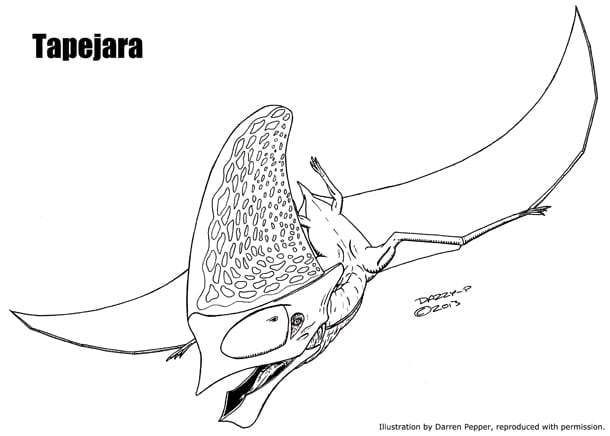
As a living pterosaur, the crest on Tapejara would have almost certainly been a display device as opposed to functional appendage. By the time of the mid Cretaceous when Tapejara lived, the pterosaurs had developed a multitude of different crests of various shapes and sizes. Had the reason for the crest been aerodynamic, it would have been likely that the pterosaurs would have developed only one or two different kinds to suit different lifestyles.
No one seems able to agree on a single feeding strategy for Tapejara. Although most have depicted Tapejara as piscivorous, plucking fish out from the sea, some have suggested the beak as being more suited for feeding upon the fruits of mid Cretaceous plants. Some depictions even have Tapejara living as a scavenger, flying around looking for carcasses. To add further confusion to the nature of Tapejara, the scleral rings suggest a cathemeral pterosaur, meaning that Tapejara was active for short periods during both the day and the night.
Further Reading
– A new edentate pterosaur of the Lower Cretaceous from the Araripe Basin, northeast Brazil, A. W. A. Kellner – 1989. – Short note on the ingroup relationships of the Tapejaridae (Pterosauria, Pterodactyloidea, A. W. A. Kellner & D. A. Campos – 2007.