Stegoceras

Steg-oh-seh-rass.
Updated on

John Stewart

Paleoecologist

John Stewart is a distinguished paleoecologist whose work has significantly advanced our understanding of prehistoric ecosystems. With over two decades dedicated to unearthing fossils across Asia and Africa

Cite Feedback Print

Name

Stegoceras ‭(‬horned roof‭)‬.

Phonetic

Steg-oh-seh-rass.

Named By

Classification

Chordata,‭ ‬Reptilia,‭ ‬Dinosauria,‭ ‬Ornithischia,‭ Pachycephalosauria.

Diet

Herbivore.

Species

S.‭ ‬validum‭

Size

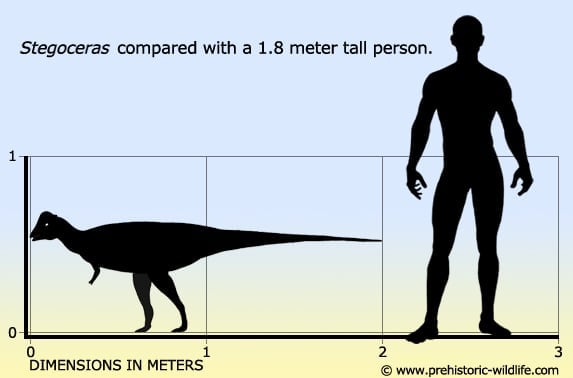
Estimated at about‭ ‬2‭ ‬meters long.

Known locations

Canada,‭ ‬Alberta‭ ‬-‭ ‬Belly River Group and Saskatchewan‭ ‬-‭ ‬Judith River Formation.‭ ‬USA,‭ ‬Montana‭ ‬-‭ ‬Hell Creek Formation,‭ ‬Judith River Formation,‭ ‬and New Mexico‭ ‬-‭ ‬Fruitland Formation‭ ‬-‭ ‬Kirtland Formation.

Time Period

Campanian of the Cretaceous.

Fossil representation

Multiple individuals.

Stegoceras: Research Database

Pachycephalosauridae (Ornithischia) · Late Cretaceous (~77–73 MYA) · North America — Canada, Alberta (Dinosaur Park Formation); USA, Montana


Research Note: Stegoceras was a pachycephalosaurid ornithischian from the Late Cretaceous of western North America, best known from numerous well-preserved skull specimens. As one of the most completely understood pachycephalosaurs — with abundant material spanning juveniles to adults — it serves as a model taxon for understanding pachycephalosaur growth, taxonomy, and the controversial function of thickened dinosaur skulls.


Research Finding Status Grade Year Method Citation Impact
Longrich 2015: Stegoceras and new data on pachycephalosaurid cranial morphology and taxonomy
Longrich 2015 provides comprehensive data on Stegoceras from the Late Cretaceous of North America, establishing it as a well-understood pachycephalosaurid with a growth series from juveniles to adults, and documenting its significance for understanding pachycephalosaur growth dynamics and taxonomic validity
Confirmed A 2015 Fossil Longrich, Cretaceous Research Growth
Pereda-Suberbiola 1994: Stegoceras and the pachycephalosaurid dinosaur fauna of the Late Cretaceous of North America
Pereda-Suberbiola 1994 provides comprehensive anatomical and taxonomic data on Stegoceras and pachycephalosaurid diversity in the Late Cretaceous of North America, establishing it as a key taxon for understanding the systematics and paleobiogeography of North American pachycephalosaurs
Confirmed A 1994 Fossil Pereda-Suberbiola, Palaeontographica Taxonomy
Status:
Confirmed Direct evidence
Grade:
A Strong consensus
B Good evidence


Active Debate: Head-Butting Mechanics, Dome Function, and Pachycephalosaur Social Behavior

Whether Stegoceras used its thickened skull for head-to-head combat (like bighorn sheep), flank-butting (like some artiodactyls), or primarily for social display is one of the classic debates in dinosaur paleontology. Unlike the dramatically domed Pachycephalosaurus, Stegoceras has a more moderate dome, leading some researchers to argue it may have used its head differently — perhaps in open-palm strikes rather than direct ramming. The bone histology of Stegoceras skull domes has been studied to look for evidence of healed trauma, which would support the head-butting hypothesis, but the results are ambiguous — some specimens show pathology consistent with impact, while others show no such evidence.

The ontogeny of the Stegoceras dome is also debated. Whether the dome grew gradually throughout life (as in some modern ungulates) or whether it was a rapid transformation associated with sexual maturity (as in some birds) has implications for interpreting isolated pachycephalosaur skulls. Some researchers have suggested that specimens with less-developed domes previously assigned to separate genera (Ornatops, Colepiocephale) may simply be juvenile Stegoceras specimens, which would have major taxonomic implications.


What We Still Do Not Know About Stegoceras

  • Social behavior: Likely gregarious; no direct evidence.
  • Dome function: Combat vs display debated.
  • Diet: Likely herbivorous; tooth morphology consistent.
  • Growth patterns: Growth series studied but ontogeny debated.

In Depth

       Stegoceras is one of the more common and better known pachycephalosaurs,‭ ‬and one that seems to have had a range that extended from South west/central Canada to the south western states of the USA.‭ ‬The genus however seems to have been quite a bit smaller than its more famous relative‭ ‬Pachycephalosaurus.

       Like with all pachycephalosaurs,‭ ‬the skull of Stegoceras is noted for having extreme thickening which‭ ‬would have resulted in a dome-like structure on top of the skull.‭ ‬In Stegoceras the bone that would have made up the dome would be around‭ ‬seventy-five millimetres at its maximum thickness.‭ ‬The eyes are also interesting to note‭ ‬as the eye sockets would have faced forwards,‭ ‬which means that Stegoceras would have also had a fairly good degree of stereoscopic vision,‭ ‬meaning depth perception.‭ ‬Stegoceras was also once noted as the only ornithischian dinosaur to have gastralia‭ (‬belly ribs‭)‬,‭ ‬however these have now been re-examined and realised to be ossified tendons.

       In‭ ‬1983‭ ‬a species of Stegoceras named S.‭ ‬browni was established as a distinct genus named Ornatotholus.‭ ‬This was noted as a flat headed pachycephalosur,‭ ‬however it now seems that the flat headed forms of pachycephalosaurs are actually the juvenile and under developed forms of the dome-headed genera which are adults.‭ ‬Ornatotholus is now regarded as a juvenile of and hence synonym to the Stegoceras type species S.‭ ‬validum.

       Also like with other pachycephalosaurs Stegoceras was once popularly thought to be a‭ ‘‬head butter‭’‬,‭ ‬the thick dome of the skull being used to deal out and absorb impacts.‭ ‬This is not that widely accepted anymore however with some studies suggesting the bone of the skull would have actually not been strong enough to repeatedly absorb hits,‭ ‬others suggesting that it was not of a correct shape to maximise impact area.‭ ‬Other still suggest that‭ ‘‬flank butting‭’‬,‭ ‬where the head was used to give out impacts to the sides of animal would have been more likely given the apparent fragility of the skull.

Further Reading

-‭ ‬New genera and species from the Belly River Series‭ (‬mid-Cretaceous‭)‬.‭ ‬-‭ ‬Geological Survey of Canada Contributions to Canadian Palaeontology‭ ‬3‭(‬2‭)‬:25-81‭ ‬-‭ ‬Lawrence Lambe‭ ‬-‭ ‬1902. Agonistic behavior in pachycephalosaurs‭ (‬Ornithischia:‭ ‬Dinosauria‭)‬:‭ ‬a new look at head-butting behavior.‭ ‬-‭ ‬Contributions to Geology‭ ‬32‭ (‬1‭)‬:‭ ‬19‭–‬25.‭ ‬-‭ ‬Kenneth Carpenter‭ ‬-‭ ‬1997. -‭ ‬Dinosaur gastralia:‭ ‬origin,‭ ‬morphology,‭ ‬and function.‭ ‬-‭ ‬Journal of Vertebrate Paleontology‭ ‬24‭ (‬1‭)‬:‭ ‬89‭–‬106.‭ ‬-‭ ‬Leon‭ ‬P.‭ ‬A‭ ‬.M.‭ ‬Claessens‭ ‬-‭ ‬2004. -‭ ‬Cranial Ontogeny in Stegoceras validum‭ (‬Dinosauria:‭ ‬Pachycephalosauria‭)‬:‭ ‬A Quantitative Model of Pachycephalosaur Dome Growth and Variation.‭ ‬-‭ ‬PLoS ONE‭ ‬6‭ (‬6‭)‬:‭ ‬e21092.‭ ‬-‭ ‬Ryan K.‭ ‬Schott,‭ ‬David C.‭ ‬Evans,‭ ‬Mark B.‭ ‬Goodwin,‭ ‬John R.‭ ‬Horner,‭ ‬Caleb Marshall Brown‭ & ‬Nicholas R.‭ ‬Longrich‭ ‬-‭ ‬2011. -‭ ‬Re-evaluation of pachycephalosaurids from the Fruitland-Kirtland transition‭ (‬Kirtlandian,‭ ‬late Campanian‭)‬,‭ ‬San Juan Basin,‭ ‬New Mexico,‭ ‬with a description of a new species of Stegoceras and a reassessment of Texascephale langstoni.‭ ‬-‭ ‬Fossil Record‭ ‬3.‭ ‬New Mexico Museum of Natural History and Science,‭ ‬Bulletin‭ ‬53:‭ ‬202‭–‬215.‭ ‬-‭ ‬Steven E.‭ ‬Jasinski and Robert M.‭ ‬Sullivan‭ ‬-‭ ‬2011. – Squamosal Ontogeny and Variation in the Pachycephalosaurian Dinosaur Stegoceras validum Lambe, 1902, from the Dinosaur Park Formation, Alberta. – Journal of Vertebrate Paleontology. 32 (4): 903–913. – R. K. Schott & D. C. Evans – 2012.
Adopt A Species
prehistoric-wildlife new logo

Love this species?

Adopt it today!

(UPDATED!)

SPECIES SPOTLIGHT

Mosasaurus