In Depth
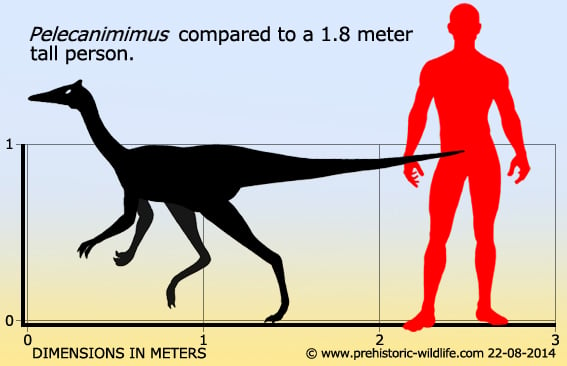
Pelecanimimus is a special dinosaur as it is considered to be one of if not the earliest known ornithomimosaur. Pelecanimimus also stands out from later forms because of the large number of teeth that are still present within its mouth, around two hundred and twenty in total. These teeth are thought to have given Pelecanimimus a bite that cut and ripped, but in later forms these teeth would become replaced with a keratinous beak that did much the same job.
There is a lot of debate and study regarding what later ornithomimosaurs ate because their keratinous beaks could have been used for a variety of feeding habits upon both animals and plants. Palaeontologists are a little more confident in calling Pelecanimimus a predator however because of one special feature. Soft tissue remains have revealed the presence of a gular pouch similar to those seen in pelicans (hence the name which means ‘pelican mimic’). Pelecanimimus is thought to have lunged into water to catch fish and possibly other small aquatic vertebrates like frogs which were stored in the pouch until the excess water could be passed out of the mouth and prey finally eaten.
Pelecanimimus also had a keratinous head crest that rose up from the back of the head. The bones in the lower arm are placed tight together for additional rigidity and the claws growing from the ends of the fingers are straight, something that is more common in primitive ornithomimosaurs. It’s possible that the hands and claws also played a part in prey capture, or even feeding. Soft tissue impressions also reveal that the skin was bare and scaley which indicates that Pelecanimimus did not have a feather covering.
By living and hunting in shallow waters means it is quite possible that Pelecanimimus would have come into contact with spinosaurid dinosaurs such as Baryonyx. Spinosaurids are today thought to have been specialist fish hunters, but a small dinosaur like Pelecanimimus might still have been a tempting snack for a hungry Baryonyx, which is why it is conceivable that Pelecanimimus would have given this dinosaur a wide birth. Actual competition between them for the same food would have probably been very minor since Pelecanimimus would have been restricted to only small sized prey, whereas Baryonyx as the larger dinosaur could have taken larger prey.
Pelecanimimus also coexisted with the bizarre theropod Concavenator that had humps over its hips. Iguanodon, one of the most common of the European plant eating dinosaurs of the Cretaceous is also well represented from the same formation. There were also primitive birds such as Eoalulavis and Iberomesornis.
Further Reading
– A unique multitoothed ornithomimosaur from the Lower Cretaceous of Spain. – Nature, 370: 363-367. – B. P. Perez-Moreno, J. L. Sanz, A. D. Buscalioni, J. J. Moratalla, F. Ortega & D. Raskin-Gutman – 1994.