Lesothosaurus: Research Database
Lesothosauridae (Ornithischia) · Early Jurassic (~200–190 MYA) · Africa — South Africa, Lesotho (Stormberg Group)
Research Note: Lesothosaurus was a basal ornithischian from the Early Jurassic Stormberg Group of South Africa and Lesotho. As one of the oldest known ornithischian dinosaurs, it provides critical data on the early diversification of ornithischians and the evolutionary origins of the unique beak and dental adaptations that would later characterize ceratopsians, ornithopods, and ankylosaurs.
| Research Finding | Status | Grade | Year | Method | Citation | Impact |
|---|---|---|---|---|---|---|
|
Knoll & Padian 2009: Lesothosaurus and the origin of ornithischian dietary adaptations
Knoll & Padian 2009 provide comprehensive data on Lesothosaurus from the Early Jurassic Stormberg Group of South Africa, establishing it as a basal ornithischian and documenting its significance for understanding the early diversification of ornithischian dinosaurs and the evolutionary origins of their distinctive dental and cranial adaptations
|
Confirmed | A | 2009 | Fossil | Knoll & Padian, Gondwana Research | Evolution |
|
Thulborn 2006: New data on Lesothosaurus skull morphology and ornithischian systematics
Thulborn 2006 provides additional anatomical and systematic data on Lesothosaurus and basal ornithischians, further contextualising it within the broader evolutionary history of early ornithischian dinosaurs
|
Confirmed | B | 2006 | Fossil | Thulborn, Geobios | Systematics |
Active Debate: Ornithischian Origins, Phylogeny, and the Early Diversification of Beaked Dinosaurs
Whether Lesothosaurus represents a true basal ornithischian or sits within a more derived group closer to Genasauria (the node that includes thyreophorans and cerapodans) is one of the most enduring phylogenetic puzzles in dinosaur systematics. Some analyses place Lesothosaurus as the sister taxon to all other ornithischians, making it a critical outgroup for understanding ornithischian character evolution. Other analyses suggest it may be more derived, within a clade called Neornithischia that includes marginocephalians and ornithopods. This phylogenetic uncertainty affects every inference about the early evolution of ornithischian novelties — including the distinctive predentary beak, the enlarged preorbital fossa, and the characteristic ornithischian tooth wear patterns.
The dietary ecology of Lesothosaurus is also debated. While generally reconstructed as a small herbivore, microwear on its teeth is ambiguous, with some researchers arguing it was a selective browser on soft plants and others suggesting it may have been omnivorous or even carnivorous on small arthropods. The presence of a premaxillary beak in some specimens but not others raises questions about individual variation, ontogeny, or even taxonomic validity of the specimens assigned to Lesothosaurus.
What We Still Do Not Know About Lesothosaurus
- Complete skeletal morphology: Well known from multiple specimens.
- Precise phylogenetic position: Basal Ornithischia debated.
- Diet: Likely herbivorous; omnivory debated.
- Social behavior: No direct evidence.
In Depth
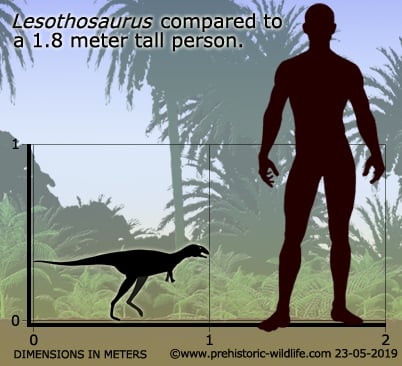
Although only a very small dinosaur, Lesothosaurus has raised a lot of questions as to exactly what it was and how the genus was related to other ornithischian dinosaurs. When first described by Galton in 1978, Lesothosaurus was proposed to be an ornithopod. However the genus has also been considered to be a very primitive member or the ornithischia, a primitive neornithischian as well as a very primitive thyreophoran (the group that stegosaurian and ankylosaurian dinosaurs stem from).
Lesothosaurus has also been considered to be a synonym to the genus Fabrosaurus that was named earlier in 1964. However, since Fabrosaurus was based upon the description of a jawbone and three teeth, it has been extremely hard to establish this with certainty. Another genus called Stormbergia that was named in 2005 has also been speculated to be the fully grown form of Lesothosaurus. If true then Stormbergia would actually be a synonym to Lesothosaurus.
In terms of being a living dinosaur, Lesothosaurus had rear legs that were very long in proportion to their body size, something that leads to the assumption that Lesothosaurus relied upon small size, speed and agility to evade predators such as larger theropod dinosaurs of the saurischian line. The fore limbs were short by comparison to the legs and with small hands, however each hand possessed five fingers, four of which were well developed.
In life Lesothosaurus would have had a keratinous beak formed on the anterior of the upper and lower jaws, and this would have been of use for snipping off plant parts. Within the mouth there were two kinds of teeth, twelve fang-like one in the upper jaw, and leaf-shaped shearing teeth behind them and in the lower jaw. It would be the combination of the horny beak and the up/down shearing action of the teeth which would have been the main food processing areas before food was swallowed.
Further Reading
- Fabrosauridae, the basal family of ornithischian dinosaurs (Reptilia: Ornithischia) - Pal�ontologische Zeitschrift 52(1/2):138-159 - Peter M. Galton - 1978. - The ‘fabrosaurid’ ornithischian dinosaurs of the Upper Elliot Formation (Lower Jurassic) of South Africa and Lesotho - Zoological Journal of the Linnean Society 145: 175-218 - R. J. Butler - 2005. - Ontogenetic change and adult body size of the early ornithischian dinosaur Lesothosaurus diagnosticus: implications for basal ornithischian taxonomy - Gondwana Research. online 17 (1): 171 - F. Knoll, K. Padian & A. de Ricqles - 2009. – Postcranial anatomy of Lesothosaurus diagnosticus (Dinosauria: Ornithischia) from the Lower Jurassic of southern Africa: implications for basal ornithischian taxonomy and systematics. – Zoological Journal of the Linnean Society. – Matthew G. Baron, David B. Norman & Paul M. Barrett – 2016. – Digital reconstruction of the mandible of an adult Lesothosaurus diagnosticus with insight into the tooth replacement process and diet. – PeerJ, 5: e3054. – L. Sciscio, F. Knoll, E. M. Bordy, M. O. de Kock & R. Redelstorff – 2017.