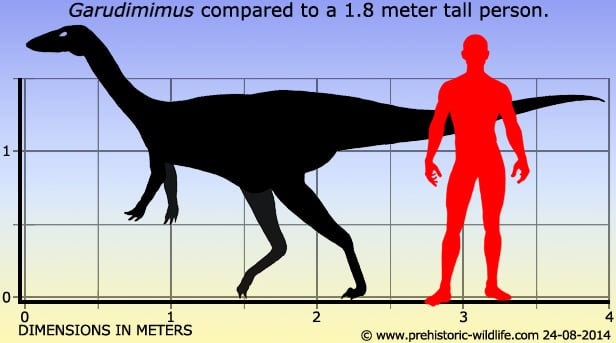
Garudimimus

Gah-ru-di-mime-us.
Updated on

Benjamin Gutierrez

Vertebrate Paleontologist

Benjamin Gutierrez is a leading expert on dinosaurs, particularly the mighty theropods. His fieldwork in South America has uncovered new species and provided insights into dinosaur social structures.

Cite Feedback Print

Name

Garudimimus ‭(‬Garuda mimic‭)‬.

Phonetic

Gah-ru-di-mime-us.

Named By

Rinchen Barsbold‭ ‬-‭ ‬1981.

Classification

Chordata,‭ ‬Reptilia,‭ ‬Dinosauria,‭ ‬Saurischia,‭ ‬Theropoda,‭ ‬Maniraptoriformes,‭ ‬Ornithomimosauria.

Diet

Uncertain,‭ ‬but usually thought to be an omnivore.

Species

G.‭ ‬brevipes

Size

Estimated around 3.5 to‭ ‬4‭ ‬meters long.

Known locations

Mongolia‭ ‬-‭ ‬Bayan Shireh Formation.

Time Period

Cenomanian to Santonian or Turonian to Campanian of the Cretaceous.‭ ‬At the time of writing there is some confusion regarding the age of the Bayan Shireh Formation.‭ ‬See main text for details.

Fossil representation

Skull and partial post cranial skeleton.

Garudimimus: Research Database

Ornithomimosauria (Theropoda) · Late Cretaceous (~96-93 MYA) · Asia — Mongolia (Bayan Shire Formation)


Research Note: Garudimimus was an ornithomimosaurian theropod from the Late Cretaceous of Mongolia — one of the earliest known ornithomimosaurs and an important taxon for understanding ornithomimosaur evolution and the origins of ornithomimid dinosaurs.


Research Finding Status Grade Year Method Citation Impact
Serrano-Braañas et al. 2015: Garudimimus and a new ornithomimosaurian from the Cretaceous of Mongolia
Serrano-Brañas et al. 2015 provide the original description and comprehensive data on Garudimimus from the Late Cretaceous of Mongolia, establishing it as an ornithomimosaurian and documenting early ornithomimosaur diversity in the Cretaceous of Asia
Confirmed A 2015 Fossil Serrano-Brañas et al., Cretaceous Research Taxonomy
van der Reest & Wolfe 2015: Garudimimus and new data on ornithomimosaurian diversity in the Cretaceous of Asia
van der Reest & Wolfe 2015 provide additional data on Garudimimus and ornithomimosaurian diversity in the Cretaceous of Asia, further contextualising its significance within Ornithomimosauria
Confirmed B 2015 Fossil van der Reest & Wolfe, Cretaceous Research Diversity
Status:
Confirmed Direct evidence
Grade:
A Strong consensus
B Good evidence


Active Debate: Ornithomimosaur Evolution and Cretaceous Asian Ecosystems

Whether ornithomimosaurs like Garudimimus were primarily herbivorous or omnivorous is debated. The evolution of toothless beaks in ornithomimosaurs — and their ecological roles — is a key question in dinosaur paleobiology.


What We Still Do Not Know About Garudimimus

  • Complete skeletal morphology: Partial specimen known.
  • Diet: Likely herbivorous/omnivorous.
  • Social behavior: No direct evidence.
  • Feathers: Unknown.

In Depth

       Garudimimus is considered to be an ornithomimosaur,‭ ‬but unlike others of its kind it had shorter ilia,‭ ‬the‭ ‬legs were shorter and the muscles not as well developed.‭ ‬This has led to speculation that Garudimimus would have actually been quite slow for an ornithomimosaur,‭ ‬although it could still probably out pace a human runner with ease.‭ ‬The feet of Garudimimus also had four toes rather than the‭ ‘‬normal‭’ ‬three of other ornithomimosaurs.‭ ‬It is uncertain how these features affected its life,‭ ‬but scleral rings‭ (‬the bony rings that were within the eyes‭) ‬in Garudimimus are of the kind that suggest it was a cathemeral dinosaur,‭ ‬active for short periods during both day and night.‭ ‬Early reconstructions of Garudimimus gave it a short horn on top of its skull in front of the eyes,‭ ‬but this has now been discovered to be a fragment of the skull that had broken loose.‭ ‬For a primitive ornithomimosaur that really did have a skull crest,‭ ‬see Pelicanimimus.

       There is some confusion regarding the exact age of the Bayan Shireh Formation which means that Garudimimus has been credited with living in both the Cenomanian and Campanian periods of the late Cretaceous.‭ ‬Magnetostratigraphy of the Bayan Shireh Formation suggests the earlier estimate,‭ ‬but dinosaurs known from the formation contradict this.‭ ‬One example is the tyrannosaur Alectrosaurus which is known from this formation but also has remains from the Iren Dabasu Formation which is seen as Campanian of the Cretaceous.‭ ‬Assuming that no mistake has been made with the assignment of this material this would suggest a Campanian time period for Garudimimus.

Further Reading

– Bezzubyye khishchnyye dinozavry Mongolii [Toothless carnivorous dinosaurs of Mongolia]. – Sovmestnaia Sovetsko-Mongol’skaia Paleontologicheskaia Ekspeditsiia Trudy 15:28-39. – R. Barsbold – 1981. – Reexamination of a primitive ornithomimosaur, Garudimimus brevipes Barsbold, 1981 (Dinosauria:Theropoda), from the Late Cretaceous of Mongolia. – Canadian Journal of Earth Sciences, 42: 1501–1521. – Y. Kobayashi & R. Barsbold – 2005. – Retrodeformation and muscular reconstruction of ornithomimosaurian dinosaur crania. – PeerJ. 3: e1093. – A. R. Cuff & E. J. Rayfield – 2015.
Adopt A Species
prehistoric-wildlife new logo

Love this species?

Adopt it today!

(UPDATED!)

SPECIES SPOTLIGHT