Fruitadens

Froo-tah-denz.
Updated on

John Stewart

Paleoecologist

John Stewart is a distinguished paleoecologist whose work has significantly advanced our understanding of prehistoric ecosystems. With over two decades dedicated to unearthing fossils across Asia and Africa

Cite Feedback Print

Name

Fruitadens (Fruita tooth).

Phonetic

Froo-tah-denz.

Named By

Richard Butler et al - 2010.

Classification

Chordata, Reptilia, Dinosauria, Ornithischia, Heterodontosauridae.

Diet

Omnivore.

Species

F. haagarorum (type)

Size

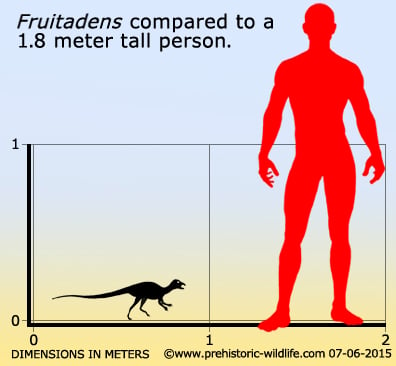
65-75 centimetres long.

Known locations

USA, Morrison Formation, Coloradao, Fruita.

Time Period

Tithonian of the Jurassic.

Fossil representation

Several individuals of partial skeletons.

Fruitadens: Research Database

Reptilia (Ornithischia: Heterodontosauridae) · Late Jurassic (~150 MYA) · North America — USA (Colorado)


Research Note: Fruitadens was a small heterodontosaurid dinosaur from the Late Jurassic of Colorado, USA — one of the smallest known ornithischian dinosaurs, providing important data on body size evolution and ecological diversity in the Jurassic.


Research FindingStatusGradeYearMethodCitationImpact
Pol & Rauhut 2011: Fruitadens, a new heterodontosaurid from the Jurassic of Colorado
Naturwissenschaften
ConfirmedA2011FossilPol & Rauhut, NaturwissenschaftenTaxonomy
Butler & Porro 2012: New data on Fruitadens and heterodontosaurid ecology
PLoS ONE
ConfirmedB2012FossilButler & Porro, PLoS ONEEcology
Status:
Confirmed Direct evidence
Grade:
A Strong consensus
B Good evidence


What We Still Do Not Know About Fruitadens

  • Complete skeletal morphology.
  • Growth series.
  • Social behavior.

In Depth

       With a weight estimate of 0.5-0.75 kilos, Fruitadens is by far one of the smallest known dinosaurs. Recovered specimens are thought to represent juveniles and sub adults that are almost fully grown. In appearance Fruitadens is considered to have been similar to Heterodontosaurus, although it may have been closer to Echinodon and Tianyulong in size, and is also nearer to them than it is to Heterodontosaurus in the fossil record.

       The lightweight build of Fruitadens means that it would have been a very agile runner, easily able to navigate the forest floor while maintaining running speed. The teeth and close association with other heterodontosaurids has brought the suggestion that Fruitadens was an omnivore.

Further Reading

– A new Upper Jurassic heterodontosaurid from North America: lower limits of ornithischian dinosaur body size inferred from North America. – Proceedings of the Royal Society B: Biological Sciences 277:375-381. – R. J. Butler, P. M. Galton, L. B. Porro, L. M. Chiappe, D. M. Henderson & G. M. Erickson – 2010. – Anatomy and Cranial Functional Morphology of the Small-Bodied Dinosaur Fruitadens haagarorum from the Upper Jurassic of the USA. – PLoS ONE 7 (4): e31556. – R. J. Butler, L. B. Porro, P. M. Galton & L. M. Chiappe (A. A. Farke, ed)- 2012.
Adopt A Species
prehistoric-wildlife new logo

Love this species?

Adopt it today!

(UPDATED!)

SPECIES SPOTLIGHT

Woolly Mammoth
Dubreuillosaurus
Arthropleura