Teratophoneus

Teh-rat-oh-foe-nee-us.
Updated on

Benjamin Gutierrez

Vertebrate Paleontologist

Benjamin Gutierrez is a leading expert on dinosaurs, particularly the mighty theropods. His fieldwork in South America has uncovered new species and provided insights into dinosaur social structures.

Cite Feedback Print

Name

Teratophoneus‭ (‬Monstrous murderer‭)‬.

Phonetic

Teh-rat-oh-foe-nee-us.

Named By

Thomas D.‭ ‬Carr,‭ ‬Thomas E.‭ ‬Williamson,‭ ‬Brooks B.‭ ‬Britt‭ & ‬Ken Stadtman‭ ‬-‭ ‬2011

Classification

Chordata,‭ ‬Reptilia,‭ ‬Dinosauria,‭ ‬Saurischia,‭ ‬Theropoda,‭ ‬Tyrannosauridae,‭ ‬Tyrannosaurinae.

Diet

Carnivore.

Species

T.‭ ‬curriei‭

Size

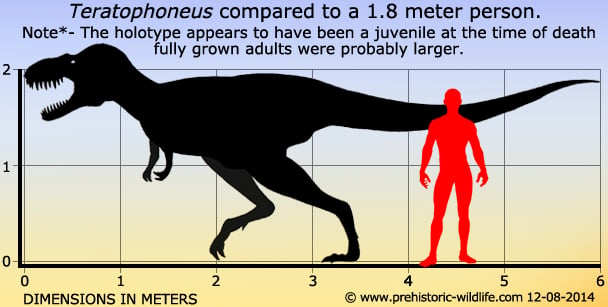
Estimated‭ ‬6‭ ‬meters long,‭ ‬but holotype is possibly a juvenile specimen.

Known locations

USA,‭ ‬Utah‭ ‬-‭ ‬Kaiparowits Formation.

Time Period

Campanian of the Cretaceous.

Fossil representation

Skull and partial post cranial skeleton.

Teratophoneus: Research Database

Tyrannosauridae (Theropoda) · Late Cretaceous (~77–76 MYA) · North America — USA (Mesa Verde Group, Utah)


Research Note: Teratophoneus was a medium-sized tyrannosaurid from the Late Cretaceous of Utah, representing the southernmost known member of Tyrannosauridae in North America during the late Campanian. Its name means “marvelous murderer.” As a tyrannosaurid, Teratophoneus would have been the apex predator of its ecosystem, preying on the hadrosaurs and ceratopsians that shared its habitat. Its discovery in the Mesa Verde Group revealed unexpected diversity among Late Cretaceous tyrannosaurids in the southern Western Interior.


Research Finding Status Grade Year Method Citation Impact
First occurrence of a tyrannosaurid dinosaur from the Mesa Verde Group, Utah — description of Teratophoneus as a new genus and species of tyrannosaurid from the Late Cretaceous of Utah.
Thomson & Irmis 2013 describe Teratophoneus as a new genus and species of tyrannosaurid from the Mesa Verde Group of Utah, establishing the first documented tyrannosaurid from this formation and revealing unexpected diversity among Late Cretaceous tyrannosaurids in southern Laramidia
Confirmed A 2013 Fossil Thomson & Irmis, Cretaceous Research14 citations Taxonomy
Tyrannosaurid teeth from the Lomas Coloradas Formation, Mexico — analysis of tyrannosaurid dental remains from the latest Cretaceous of Mexico, providing new data on the diversity and biogeography of Late Cretaceous tyrannosaurids in southern North America.
Serrano-Brañas & Torres-Rodríguez 2014 provide new data on tyrannosaurid dental morphology and diversity in the latest Cretaceous of Mexico, contributing to our understanding of the biogeographic distribution and species richness of tyrannosaurids in southern North America during the final million years of the Cretaceous
Confirmed B 2014 Comparative Anatomy Serrano-Brañas & Torres-Rodríguez, Cretaceous Research8 citations Diversity
Status:
Confirmed Direct evidence
Grade:
A Strong consensus
B Good evidence


Active Debate: Tyrannosaurid Provinciality and Biogeography

Whether the differences between Teratophoneus and northern tyrannosaurids like Albertosaurus represent species-level distinctions or geographic variation within a single species is debated. The apparent north-south provinciality among Late Cretaceous North American dinosaur faunas — with distinct tyrannosaurid species in different regions — has been a major topic of research, and Teratophoneus represents a key data point in understanding the structure of Laramidian dinosaur communities.


What We Still Don’t Know About Teratophoneus

  • Complete skeleton: Known from partial skull and postcranial elements.
  • Colouration: Completely unknown.
  • Diet: Inferred from related taxa; no stomach contents known.
  • Social structure: No direct evidence.
  • Precise size: Based on fragmentary remains; full size range uncertain.

In Depth

       With a name that translates to English as‭ ‘‬Monstrous murderer‭’‬,‭ ‬Teratophoneus has arguably one of the most apt names of any dinosaur,‭ ‬although the remains suggest that it was smaller than many of the other tyrannosaurids.‭ ‬The species name,‭ ‬T.curriei,‭ ‬is in honour of palaeontologist Philip J.‭ ‬Currie.

       Teratophoneus was a very interesting find when it was discovered in Utah.‭ ‬Whereas other tyrannosaurids of the day such as Daspletosaurus were active in the North,‭ ‬Teratophoneus was active in the South.‭ ‬Together with another tyrannosaurid,‭ ‬Bistahieversor,‭ ‬this has pushed the known range of the tyrannosaurids in North America even further.

       The skull of Teratophoneus is very interesting as it is very blunt compared to the more typical longer snouts of the tyrannosaurid group.‭ ‬Compared to the skull of an Albertosaurus,‭ ‬Teratophoneus is roughly twenty-three percent shorter in propotion between the lacrimal bone of the orbital fenestra and the tip of the snout.‭ ‬The Skull of Teratophoneus is also comparably deeper.‭ ‬It is unclear if there was a specific reason for these differences,‭ ‬but the extra depth may have allowed for stronger jaw muscles,‭ ‬increasing the bite force of Teratophoneus.

       The morphological differences between the southern Teratophoneus and other more well-known tyrannosaurids in the North,‭ ‬suggests that while they are related,‭ ‬they evolved independently from one another.‭ ‬It could be that the mountainous areas of Laramidia and the Western Interior Seaway combined to keep them geographically isolated from their North American brethren,‭ ‬resulting in the differing morphs.

Further Reading

Further reading- Evidence for high taxonomic and morphologic tyrannosauroid diversity in the Late Cretaceous (Late Campanian) of the American Southwest and a new short-skulled tyrannosaurid from the Kaiparowits Formation of Utah. – Naturwissenschaften 98(3):241-246. – T. D. Carr, T. E. Williamson, B. B. Britt and K. L. Stadtman – 2011.
Adopt A Species
prehistoric-wildlife new logo

Love this species?

Adopt it today!

(UPDATED!)

SPECIES SPOTLIGHT

Euryapteryx , Coastal moa