
Name:
Smilosuchus
(Knife crocodile).
Phonetic: Smie-loe-soo-kus.
Named By: R. A. Long and P. A. Murray -
1995.
Synonyms: Leptosuchus gregorii.
Classification: Chordata, Reptilia,
Archosauria, Phytosauria, Phytosauridae.
Species: S. gregorii (type).
Diet: Carnivore.
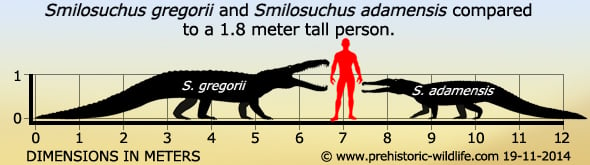
Size: Up to twelve meters long.
Known locations: USA, Arizona.
Time period: Carnian to Norian of the Triassic.
Fossil representation: Several specimens.
Phytosaurs
are generally thought of as being small crocodile-like reptiles that
averaged between two and five meters in length. Smilosuchus
however
has been estimated at up to twelve meters long, not only making it
the apex predator of its habitat, but possibly the largest
terrestrial carnivore of the Triassic. This huge size would see
Smilosuchus capable of taking down any prey from
large fish and
possibly other aquatic reptiles in the water, to rauisuchians and
primitive dinosaurs from the water’s edge.
Smilosuchus
was originally
assigned as a large species of Leptosuchus and was
classed as the species
Leptosuchus gregorii. A key characteristic of the
species was the
pronounced nasal crest that supported the nostrils (the nostrils in
phytosaurs were higher up the snout in front of the eyes, rather than
on the end of the snout like those seen in crocodiles), and in
1995 the species was re-evaluated and considered to be distinct
enough to separate it into its own genus. Thus the material became
known as Smilosuchus gregorii, the gregorii
part
being taken from the
original species classification which is standard procedure when
creating a new genus from a previously established species. However
since this has happened other palaeontologists have claimed that the
fossil material now assigned as Smilosuchus is
actually not different
enough to treat it as a distinct. As such Smilosuchus
faces an
uncertain future at the time of writing, but future fossil
discoveries may yet prove support for one theory over the other.
Regardless
of what may happen
with the Smilosuchus genus in the future, one bit
of information
which is certain is that with an upper size estimated to have been up
to twelve meters long, the phytosaurs of the Triassic could grow to
such sizes that they could rival the giant crocodiles that are known to
have existed from the much later Cretaceous to Miocene periods. The
table below presents a list that should help you to put the size of
this phytosaur into perspective. You can also click the crocodile
names if you would like much more detailed information on each of them.
| Name | Time/Location | Size (meters) |
| Deinosuchus (alligator-like crocodile). | Cretaceous/USA. | 10-12 |
| Gryposuchus (gharial-like crocodile). | Miocene/S. America. | 10 |
| Mourasuchus (alligator-like crocodile). | Miocene/Peru. | 12 |
| Purussaurus (caiman-like crocodile). | Miocene/S. America. | 11-13 |
| Rhamphosuchus (gharial-like crocodile). | Miocene/India. | 8-11 |
| Sarcosuchus (crocodile). | Cretaceous/Africa. | 11-12 |
| Smilosuchus (phytosaur *not a croc). | Triassic/USA. | 12 |
| Stomatosuchus (crocodile). | Cretaceous/Egypt. | 10 |
| 3 of todays largest living crocs below | ||
| Alligator mississippiensis (American alligator). | Present/S. E. USA. | 3.4 average - up to almost 6. |
| Crocodylus niloticus (Nile crocodile). | Present/Africa. | Average up to 5, largest up to 6.45. |
| Crocodylus porosus (Salt water crocodile). | Present/India, S. E. Asia, N. Australia. | Average 4-5.5, largest recorded 6-6.6, possibly slightly bigger. |