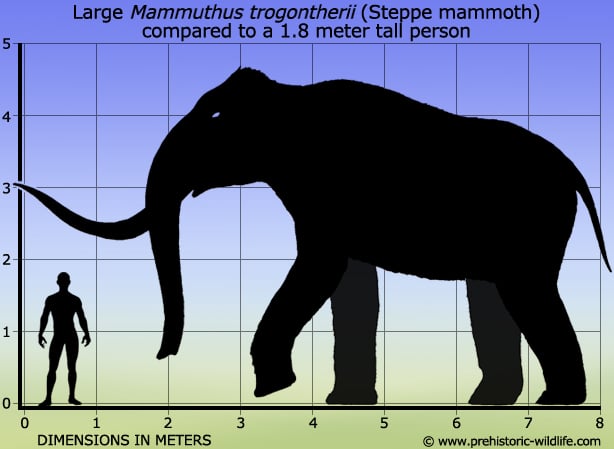
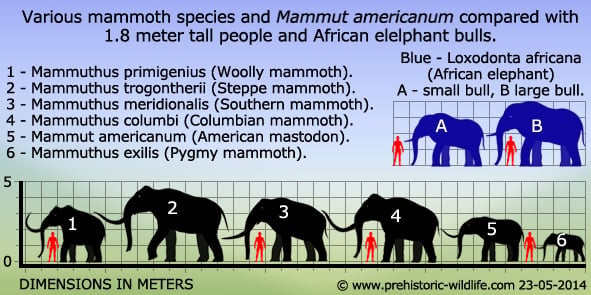
Mammuthus trogontherii, better known as the steppe mammoth, holds an important place for those who study mammoths as it is often treated as a link between the early M. meridionalis known as the southern mammoth and the later M. primigenius, more famously known as the woolly mammoth.
M. trogontherii however was larger than both its ancestor and descendent which suggests that a larger size was more suitable for its period of the Pleistocene than the times preceding and leading on from it.
Mammuthus trogontherii is generally regarded as the largest species of mammoth, though in the past there were two rivals to this. One former species, M. sungari, also known as the Songhua river mammoth was once estimated to be beyond five meters high at the shoulder, though early in the twenty-first century it was established that the M. sungari type specimen was actually composed of the remains of M. trogontherii with some associated M. primigenius remains.
Today M. sungari is regarded as a synonym to M. trogontherii. Another species, M. imperator was once considered to be a particularly large species, but now M. imperator is thought to be a synonym to M. columbi.
Steppe mammoths are known to have ranged across most of Eurasia wherever there was open plains habitat to support the growth of grasses that seem to have been the plants of choice for mammoths.
Like with others of its kind, the steppe mammoth had large broad teeth that were perfect for grinding large amounts of grasses that would have been required to keep its massive body going.
The tusks of the steppe mammoth could grow as long as five hundred and twenty centimetres, although these tusks were strongly curved and as a result would not project out for this distance. The tusks of bull (male) steppe mammoths seem to have been the most elaborate with the tips curving round so much that they would begin to point back towards the body.
Further Reading
- – Proboscidea. – In: Pleistocene mammalian fossils from the northeastern provinces: 22-34, pls. 6-15. Edited by Institute of Vertebrate Paleontology and Paleoanthropology, Chinese Academy of Sciences, China. – M. Z. Zhou – 1959.
- – Origin and evolution of the elephantidae. – Trans American Philosophical Society 633:1–149 – V. J. Vaglio – 1973.
- – The Proboscidea – Evolution and paleontology of elephants and their relatives. – United Kingdom: Oxford University Press. – J. Shoshoni & P. Tassy – 1996.
- – Causes of Northern Giants’ Extinction. – Science in Russia (Moscow: Nauka) (2): 48–53 – Alexei Tikhonov & Yuri Burlakov – 2008.
- – Mammuthus trogontherii (Pohlig, 1885), the steppe mammoth of Nolhac. Preliminary report of a left and right upper M3, excavated at the ancient maar of Nolhac, Haute-Lorie, Auvergne, France. – Quaternaire 20, (4). – Dick Mol & Frederic Lacombat – 2009.
- – New materials of the steppe mammoth, Mammuthus trogontherii, with discussion on the origin and evolutionary patterns of mammoths. – Science China Earth Sciences 53 (7): 956–963.- GuangBiao Wei, SongMei Hu, KeFu Yu, YaMei Hou, Xin Li, ChangZhu Jin, Yuan Wang, JianXin Zhao & WenHua Wang – 2010.
- – Excavation, reconstruction and conservation of steppe elephant from the clay pit of the building material factory “Toza Markovic” at Kikinda (Serbia). – Bulletin of the Natural History Museum – Milos Milivojevic – 2011.