In Depth
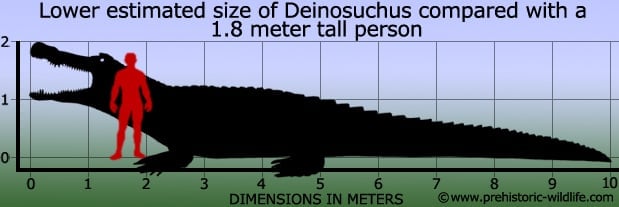
Although the first specimens were discovered in 1858, it was not until 1909 that they were correctly identified. Fossils of Deinosuchus have always been fragmentary and because of this, accurate reconstruction has been problematic. This has caused further difficulties down the line as crocodile sizes are usually estimated with comparison to the proportion of the skull to the body. Most estimates place Deinosuchus between ten and twelve meters, with twelve meters being the upper limit. Although this means that Deinosuchus was probably not as big as other giant crocodiles like Purussaurus, that would probably be little consolation to the dinosaurs of Campanian North America.
On top of the unknown size, Deinosuchus remains from the western US are larger than the Deinosuchus remains found in the east. Eastern specimens also outnumber the western specimens. Although smaller than the western specimens, the eastern Deinosuchus would have likely been the apex predators of their locale on the grounds that the larger theropod dinosaurs were mainly found in the west.
The snout of Deinosuchus resembles a modern day alligator with robust teeth that could crunch bone. These teeth combined with a powerful bites force measured in tons point towards a specialisation in hunting large and possibly armoured animals. There were many other large reptiles of the time but immediate thought is usually given to the dinosaurs. If Deinosuchus hunted dinosaurs, it probably approached them from the water as they came down to drink and lunged out at them when close enough for a strike. Having the dinosaur trapped between its jaws, and weighing many tons itself, Deinosuchus would then drag the dinosaur into the water and drown it before eating.
Deinosuchus in all likelihood did not rely exclusively upon dinosaurs for sustenance and the shells of large turtles have been found bearing teeth marks similar to those found in Deinosuchus. Further, coprolites thought to have belonged to Deinosuchus have been found to contain fragments of large turtle shells. This suggests that Deinosuchus exhibited hunting behaviour that saw a preference towards tougher and armoured prey that could not be tackled by lesser predators. This does not however suggest that Deinosuchus only ate turtles, just that they were readily available to form part of this crocodiles diet.
Potential proof of how dangerous Deinosuchus was comes from the fossils of an Albertosaurus and Appalachiosaurus. These specimens bear tooth marks that match the type of teeth that Deinosuchus had, and in one the teeth marks show signs of healing. This indicates that Deinosuchus took on a living tyrannosaurs, creatures that are thought to have been the apex predators of late Cretaceous North America.
Study of osteoderms suggest that Deinosuchus could have lived to be fifty years old and would have been constantly growing for at least the first thirty-five years of that time. By contrast study of large North American theropods such as Albertosaurus indicates that they grew fast but probably did not live beyond thirty years of age.
Further Reading
– Deinosuchus hatcheri, a new genus and species of crocodile from the Judith River beds of Montana. – Annals of the Carnegie Museum. 6: 281–294. – 1909. – How the ‘terror crocodile’ grew so big. – Nature. 398 (6724): 205–206. – Gregory M. Erickson & Christopher A. Brochu – 1999. – Habitat of the giant crocodilian Deinosuchus, Aguja Formation (Upper Cretaceous), Big Bend National Park, Texas. – Journal of Vertebrate Paleontology. 20 (Supplement to 3): 26A. – John J. Anglen, Thomas M. Lehman – 2000. – King of the Crocodylians: The Paleobiology of Deinosuchus. Indiana University Press. pp. 107–135. – David R. Schwimmer – 2002. – First occurrences of Deinosuchus in Mexico. – Journal of Vertebrate Paleontology. 26 (Supplement to 3): 138A. – James Westgate, R. Brown, Jeffery Pittman, Dana Cope & Jon Calb – 2006. – First report of the hyper-giant Cretaceous crocodylian Deinosuchus from Utah. – Geological Society of America Abstracts with Programs. 40 (1): 58. – Alan L. Titus, Michael J. Knell, Jelle P. Wiersma & Mike A Getty – 2008. – A systematic review of the giant alligatoroid Deinosuchus from the Campanian of North America and its implications for the relationships at the root of Crocodylia. – Journal of Vertebrate Paleontology. – Adam P. Cossette & Christopher A. Brochu, 2020.