In Depth
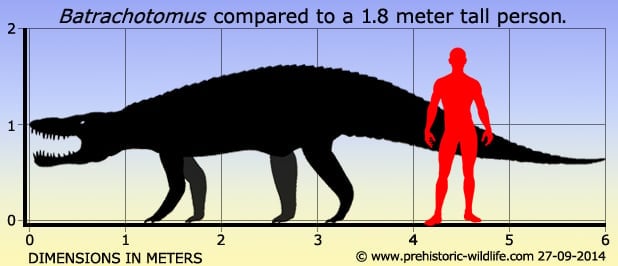
Known to have lived in Germany during the Triassic, Batrachotomus is one of the largest known rauisuchians from Europe. Sometimes dubbed a European relative of the North American Postosuchus, Batrachotomus was actually quite a bit larger than even the largest estimate for Postosuchus, and at about six meters in length, only shorter than South American rauisuchians such as Saurosuchus and Prestosuchus.
Batrachotomus is credited as being a prestosuchid rauisuchian, which means that the genus is perceived as being close to Prestosuchus in form and posture. By this association this means that Batrachotomus is likely to have been quadrupedal in stance and movement, a mode of locomotion supported by analysis of an exceptionally well preserved Prestosuchus which allowed palaeontologists to establish that the rear leg muscles were suited for limb rotation instead of mostly back and forth movement. Batrachotomus however still has fairly small forelimbs compared to the back, and when attacking prey, it is plausible that Batrachotomus would have been capable of rearing up on their hind legs. While Batrachotomus were probably quadrupedal, bipedal rauisuchians are known, with Poposaurus the best example.
Batrachotomus means ‘frog slicer’, a name that is quite unusual for a large rauisuchian predator. The idea for this name comes from the fact that fossils of the temnospondyl amphibian Mastodonsaurus have been found near the location of Batrachotomus fossils, and the fossils of Mastodonsaurus have tooth marks upon them that match up to the teeth of Batrachotomus. It is not clear if this feeding was a case of scavenging or actual hunting, but what should be remembered here is that at up to six meters long, Mastodonsaurus were comparable to large Batrachotomus, and also predators in their own right. Mastodonsaurus however seem to have been more suited to hunting softer bodied prey such as fish and other temnospondyls, and it is debateable how useful the teeth of Mastodonsaurus would have been against the armoured skin of Batrachotomus.
Another famous prehistoric amphibian that Batrachotomus shared the same habitat with is Gerrothorax, while various other amphibians and fish are also known. These animals as well the known plant fossils from the location indicate that back in the Triassic this part of Germany would have been an extensive swamp wetland. In addition to this, fossils of nothosaurs as well as Tanystropheus have also been found, all marine reptiles which indicate that this ecosystem would have been close to and perhaps even part of the coast.
Further Reading
- The cranial and mandibular osteology of a new rauisuchian archosaur from the Middle Triassic of southern Germany. - Stuttgarter Beitr�ge zur Naturkunde Serie B (Geologie und Pal�ontologie) 280:1-49. - David J. Gower - 1999. - Postcranial Anatomy of the Rauisuchian Archosaur Batrachotomus kupferzellensis - Journal of Vertebrate Paleontology 29(1):103-122. 2009 doi: http://dx.doi.org/10.1671/039.029.0122. - David J. Gower & Rainer R. Schoch - 2009.